
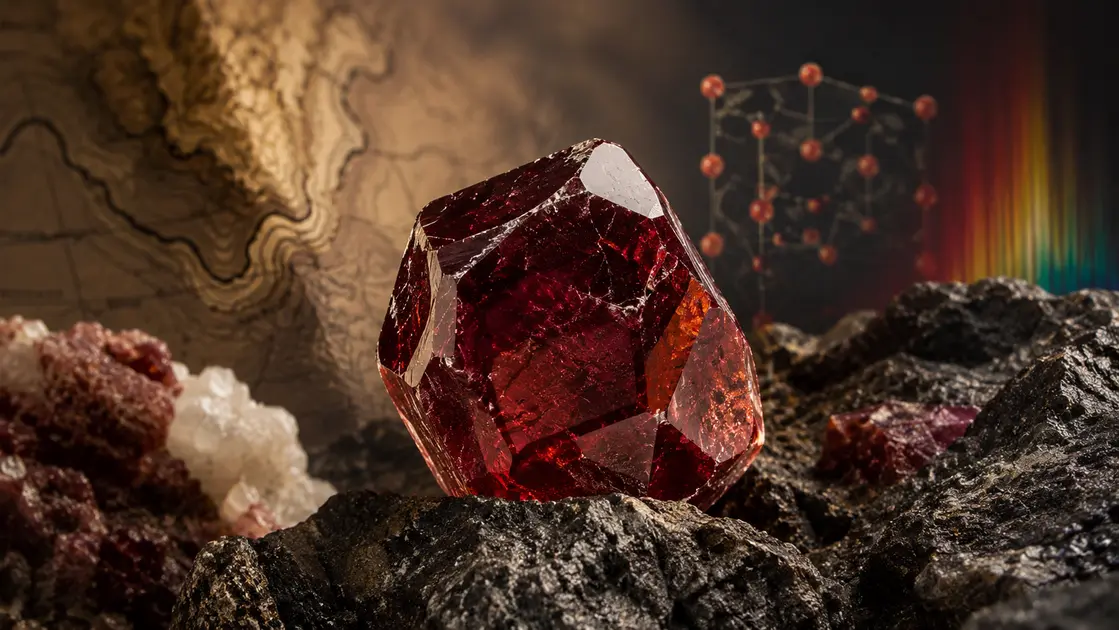
Painite is one of the few minerals whose story sounds almost impossible: a ruby-colored crystal from Myanmar was noticed by a British gemologist, examined in London, and revealed to be a completely new mineral species. Its formula, CaZrAl₉O₁₅(BO₃), places calcium, zirconium, aluminium, boron, and oxygen into a highly unusual borate structure.
Table of Contents
What Is Painite?
Painite is an extremely rare borate mineral and collector gemstone with the ideal formula CaZrAl₉O₁₅(BO₃). It is red, brownish-red, or orange-red, crystallizes in the hexagonal system, has Mohs hardness about 8, and was first described from gem gravels near Mogok, Myanmar.
Quick Facts About Painite
| Fact | Painite Data |
|---|---|
| Official name | Painite |
| Chemical formula | CaZrAl₉O₁₅(BO₃), also written CaZrAl₉(BO₃)O₁₅ |
| Mineral class | Borate; Strunz-mindat 6.AB.85 |
| IMA status | Approved, “grandfathered” because it was described before 1959 |
| IMA symbol | Pai |
| Crystal system | Hexagonal |
| Space group | P6₃/m, based on later structural refinement |
| Color | Red, brownish-red, orange-red |
| Luster | Vitreous |
| Transparency | Transparent to translucent; many specimens are not gem-clean |
| Mohs hardness | About 8 |
| Specific gravity | 4.01–4.03 measured |
| Optical character | Uniaxial negative |
| Refractive indices | nω 1.8159; nε 1.7875 |
| Discovery history | Noted by A. C. D. Pain; described as a new mineral in 1957 |
| Discovery location | Gem gravels near Mogok, Myanmar |
| Type locality | Ohngaing, Mogok Valley, Mandalay Region, Myanmar |
| Type material | Natural History Museum, London, BM 1954,192; National Museum of Natural History, Washington, D.C., 142506 |
| Known specimens | Historically only two for many years; more than 1,000 crystals/fragments reported from 2005 discoveries, but no audited global count exists |
| Museum holdings | Natural History Museum, London; National Museum of Natural History, Washington, D.C.; GIA and other institutional/research holdings are documented in literature |
| Rarity ranking | Once listed by Guinness as the world’s rarest gem; still among the rarest collector gemstones, but not supported by a fixed modern ranking |
Painite Discovery Story
From Ruby-Like Mystery to New Mineral Species
Painite’s origin story begins in the gem gravels of the Mogok region of Burma, now Myanmar. The original specimen was a small, transparent, deep garnet-red crystal weighing about 1.7 grams. Arthur Charles Davy Pain, a British gemologist and mineral collector, recognized that the crystal was unusual. It looked like a gem, but its properties did not fit ordinary ruby, spinel, or other known Mogok red stones
GIA reported that more than a thousand crystals and fragments were recovered from those discoveries, although only a small percentage was suitable for faceting.
Official Mineralogical Identity
Painite is a valid IMA mineral species, approved as “grandfathered” because it was first described before the modern IMA approval process began in 1959. Its IMA mineral symbol is Pai.
The ideal formula:
CaZrAl₉O₁₅(BO₃)
Chemical Composition
Why Painite Is Scientifically Unusual
Painite is unusual because it combines elements that do not commonly form gem-quality minerals together in this structural arrangement.
Formula Breakdown
| Component | Role in Painite |
|---|---|
| Ca | Calcium occupies channels or structural sites in the framework |
| Zr | Zirconium is a high-field-strength element and a defining part of painite chemistry |
| Al | Aluminium dominates the octahedral framework |
| B | Boron occurs as borate groups |
| O | Oxygen forms the framework around the cations |
| Cr and V | Trace chromophores contributing to red to orange-red color |
| Hf, Ti, Na | Minor or trace constituents reported in analytical work |
Crystal Structure and Crystallography
Painite crystallizes in the hexagonal system. Earlier work considered possible space groups such as P6₃, P6₃/m, or P6₃22, but later structural refinement supported P6₃/m. Mindat lists the unit cell parameters as approximately a = 8.724 Å and c = 8.464 Å, based on Armbruster and colleagues’ 2004 work.
Physical Properties of Painite
Color
Painite is typically deep red, brownish-red, orange-red, or brownish orange. Its red color is not identical to ruby’s chromium-only identity. Research on optical absorption spectra indicates that painite’s red color is caused principally by Cr³⁺ and V³⁺.
Luster
Painite has a vitreous luster, meaning polished or fresh crystal surfaces can look glassy. This contributes to its appeal as a collector gem.
Hardness
Painite has Mohs hardness around 8, making it a relatively hard gemstone material. It is harder than quartz and feldspar, but softer than corundum and diamond.
Density
Painite has a measured specific gravity of about 4.01–4.03, which is high compared with many common silicate gems. This reflects the presence of zirconium and the compact framework.
Transparency
The original crystal was transparent, and faceted stones exist, but much painite material is translucent, included, fractured, or too small for significant jewelry use.
Optical Character
Painite is uniaxial negative, with reported refractive indices of nω = 1.8159 and nε = 1.7875. Its birefringence is about 0.028.
Pleochroism
Painite may show strong pleochroism: ruby-red parallel to the c-axis and pale brownish orange or pale red-orange perpendicular to it.
Crystal Habit
Painite commonly forms elongated crystals. Some specimens are waterworn, reflecting their occurrence in gem gravels, while later discoveries include crystals and fragments from in-situ or near-primary sources.
Geological Formation of Painite
Painite is known from Myanmar, especially the Mogok region. The type occurrence is in gem gravels near Ohngaing, Mogok Valley. Mindat lists the geological setting of the type material as gem gravels, with associated minerals including corundum and phlogopite.
Confirmed Geological Facts
Painite occurs in the Mogok Stone Tract, a region famous for ruby, sapphire, spinel, and rare gem minerals. The broader Mogok geology includes marbles, schists, gneisses, calc-silicate rocks, quartzites, and igneous intrusions. Studies of Mogok ruby and related gem deposits connect parts of the region’s gem formation to high-grade metamorphism, metasomatism, and tectonic events linked to the India Asia collision.
Likely Formation Model
The safest scientific interpretation is that painite formed under rare metamorphic or metasomatic conditions in which boron-bearing fluids, aluminium-rich rocks, calcium-bearing rocks, and zirconium-bearing components interacted. This interpretation is consistent with the Mogok region’s complex combination of marbles, schists, pegmatites, intrusive rocks, and secondary gem gravels, but the exact reaction pathway for painite remains less completely established than for better-studied gems such as ruby.
Why Is Painite So Rare?
Geological Rarity Painite requires a rare geological setting. Mogok is unusual because it combines high-grade metamorphic rocks, marbles, calc-silicate assemblages, pegmatites, intrusions, and gem gravels. Many gem provinces have one or two of these conditions; Mogok has several overlapping environments. Painite combines calcium, zirconium, aluminium, boron, and oxygen. Boron-rich environments are not rare globally, and zirconium-bearing minerals such as zircon are widespread, but the specific chemical and structural conditions needed to crystallize painite are exceptional. Even where the required elements exist, they must be available at the same time, in the right chemical activity, fluid composition, temperature, pressure, and redox conditions. If one component is absent, locked in another mineral, or transported away, painite will not form. Verified painite occurrences remain concentrated in Myanmar. Mindat explicitly notes that reports of painite from Sri Lanka, Madagascar, Mozambique, and other places are incorrect or misrepresented. Painite can be visually confused with other red gem minerals. A small reddish crystal in Mogok gravels might be sorted as ruby, spinel, garnet, or zircon unless tested by a skilled gemologist or laboratory. This explains why painite may have been physically present before it was scientifically recognized. The historical collector supply was tiny. Only two crystals were known for many years, and a third was identified only in 1979. That historical scarcity created painite’s legendary reputation. The 2005 discoveries produced more than a thousand crystals and fragments, but GIA reported that only a small percentage was suitable for faceting. Most known material is too small, included, fractured, or opaque for fine gem cutting. Type material is preserved in major institutions, including the Natural History Museum in London and the National Museum of Natural History in Washington, D.C. Museum-grade painite is scarce because early specimens carry historical and scientific significance beyond gem value. Painite is not traded like diamond, ruby, sapphire, or emerald. There is no deep global exchange, no standardized price list, and no reliable volume data. Its market is thin, collector-driven, and highly dependent on documentation. Painite is verified from Myanmar. The most important region is the Mogok Stone Tract, especially the Mogok Valley and nearby localities in Mandalay Region. Mindat lists the type locality as Ohngaing, Mogok Valley, Mogok Township, Pyin-Oo-Lwin District, Mandalay Region. Ohngaing is the type locality. The original material came from gem gravels, and associated minerals include corundum and phlogopite. This locality has scientific importance because it anchors painite’s official mineral identity. The 2005 discoveries of in-situ painite at Thurein-taung and Wetloo changed painite’s availability. GIA reported more than a thousand crystals and fragments from those finds and more than 167 faceted stones known to the contributor at that time. GIA reported another source in northern Myanmar near Namya, also spelled Nanyaseik, where pale pink painite crystals were identified in heavy mineral concentrates. These were smaller and visually different from the darker reddish to orangy brown material from Mogok. Claims of painite from countries outside Myanmar should be treated cautiously. Mindat warns that reports from Sri Lanka, Madagascar, Mozambique, and other places are incorrect, misrepresented Myanmar material, or another mineral entirely. Painite has high collector interest but should not be treated like a standardized investment asset. Painite has appeared in the gem and mineral trade, especially after the early 2000s discoveries. GIA documented a 2.5 ct faceted painite identified in Thailand and later numerous small faceted stones, mostly 0.05–0.30 ct, with stones up to 1.32 ct and a reported 2.02 ct faceted stone at the time of the 2005 report. There is no reliable universal “painite price per carat.” Online listings often include questionable origin claims, unrealistic prices, or misidentified stones. Because painite is rare and thinly traded, price depends on: Painite may appreciate as a collector mineral, but it is illiquid. A rare stone is not automatically a good investment. The best reason to buy painite is scientific and collecting interest, not guaranteed financial return. Painite is a very rare borate mineral and collector gemstone from Myanmar. Its ideal formula is CaZrAl₉O₁₅(BO₃). It is usually red, brownish-red, or orange-red, has Mohs hardness about 8, and crystallizes in the hexagonal system. Painite is rare because it requires an unusual combination of calcium, zirconium, aluminium, boron, and oxygen under specific geological conditions. Its verified occurrence is limited to Myanmar, and gem-quality material is much rarer than rough fragments Yes. Painite is much rarer than diamond as a mineral and as a gem material. Diamonds are mined and traded globally in large quantities, while painite is a collector rarity from limited Myanmar occurrences. Verified painite is found in Myanmar, especially the Mogok region. Important localities include Ohngaing, Thurein-taung, Wetloo, and Namya/Nanyaseik. Claims from other countries should be treated cautiously unless confirmed by a reputable laboratory. Painite was named after Arthur Charles Davy Pain, the British gemologist and mineral collector who recognized the unusual nature of the original crystal. The mineral was formally described by Claringbull, Hey, and Payne in 1957. Painite is usually red, brownish-red, orange-red, or brownish orange. Its color is linked mainly to trace chromium and vanadium. The exact appearance depends on chemistry, orientation, transparency, and inclusions. The accepted formula is CaZrAl₉O₁₅(BO₃). It may also be written as CaZrAl₉(BO₃)O₁₅ or CaZrBAl₉O₁₈, depending on whether the borate group is emphasized separately. Painite can be a gemstone when transparent and cuttable, but most painite is collected as a mineral specimen. Faceted painite is rare, often small, and usually purchased by collectors rather than mainstream jewelry buyers. Painite’s hardness makes jewelry use possible, but it is not common. The main barriers are rarity, small sizes, inclusions, and high collector value. Protective settings and careful wear would be necessary for any painite jewelry. There is no reliable universal painite price. Value depends on verified identity, carat weight, color, clarity, cut, crystal quality, provenance, and documentation. Unverified online prices should not be treated as market benchmarks. Is painite a good investment? No audited global count exists. Historically, only two crystals were known for years. After 2005, more than a thousand crystals and fragments were reported from Myanmar, but fine faceted stones remain much less common. At the type locality, associated minerals include corundum and phlogopite. Photo-based associations also include ruby, calcite, sapphire, and spinel, reflecting the broader Mogok gem environment. Painite is not chemically related to ruby. Ruby is chromium-bearing corundum, Al₂O₃. Painite is a calcium-zirconium-aluminium borate. They may occur in the same gem region and can look superficially similar. Painite is not known as a strongly magnetic gem mineral. Its trace iron, chromium, and vanadium are important for color and chemistry, but identification should rely on gemological and mineralogical testing rather than magnetism. Painite has Mohs hardness about 8. That makes it harder than quartz and most feldspars, but softer than corundum and diamond. Hardness alone does not determine jewelry durability because cleavage, fracture, and inclusions also matter. It depends on definitions. Kyawthuite is described from a single known sample, while painite was historically called the world’s rarest gem. Painite remains one of the rarest collector gemstones, but not necessarily the rarest mineral by specimen count. Real painite should be confirmed through laboratory testing: refractive index, specific gravity, spectroscopy, microscopic examination, Raman/X-ray diffraction, and chemical analysis. Visual color is not enough because painite can resemble ruby, spinel, garnet, or zircon. Painite is not a common synthetic gemstone in jewelry markets. The larger risk for buyers is misidentification or false labeling, not widespread synthetic painite. Laboratory confirmation remains essential. Painite can show deep red to brownish-red colors and comes from a region famous for ruby. In gem gravels, small red crystals can look similar until tested. Painite’s distinct density, optical properties, and chemistry reveal its true identity. The type locality is Ohngaing, Mogok Valley, Mogok Township, Pyin-Oo-Lwin District, Mandalay Region, Myanmar. Type material is preserved in major museum collections. Verified painite is from Myanmar. Claims from Sri Lanka, Madagascar, Mozambique, and other countries are considered incorrect or questionable unless supported by strong laboratory evidence. Painite is scientifically important because of its unusual chemistry, rarity, crystal structure, relationship to other borate minerals, and role in understanding Mogok’s complex gem-forming environments. Painite crystallizes in the hexagonal system. Modern structural work supports space group P6₃/m. Its crystals are often elongated and may appear pseudo-orthorhombic externally. Painite’s measured specific gravity is about 4.01–4.03. This relatively high density helps distinguish it from many visually similar red gemstones when combined with other tests. New discoveries near Mogok and later in-situ finds at Thurein-taung and Wetloo increased the known supply. Improved awareness, targeted searching, and laboratory identification helped reveal material that might previously have gone unnoticed. Painite is rarer in terms of verified mineral occurrence and historical specimen scarcity. Red beryl is also extremely rare, especially in gem quality, but has better-known deposits and a more established collector market. Museums may acquire painite specimens when they have scientific, historical, or display value. Provenance, legality, documentation, and research value are more important than beauty alone. Buyers should request laboratory identification, provenance, locality, treatment disclosure, weight, dimensions, photos, return policy, and seller reputation. For high-value material, independent verification is essential. More painite may be found in Myanmar because later discoveries proved that the early specimen count was incomplete. However, there is no evidence that painite will become common. Its formation still requires rare geological circumstances.Chemical Rarity
Formation Rarity
Occurrence Rarity
Discovery Rarity
Collection Rarity
Gem-Quality Rarity
Museum Rarity
Market Rarity
Painite vs Other Rare Gemstones
Gem / Mineral Relative rarity Main distinction Painite comparison Kyawthuite Extreme; described from a single faceted 1.61 ct sample BiSbO₄ mineral from near Mogok Kyawthuite is rarer by confirmed specimen count; painite is more available but still exceptionally rare (Western Sydney University) Painite Extremely rare Ca-Zr-Al borate from Myanmar Historically legendary; still a top collector rarity Musgravite Very rare Taaffeite-group oxide gem More known in gem trade than early painite, but still elite collector material Taaffeite Very rare First identified from a cut gemstone mistaken for spinel Similar “mistaken identity” story, but chemically unrelated Red beryl Very rare Red Be-Al silicate, mainly Utah gem material More locality-famous; painite is more chemically unusual Jeremejevite Rare borate Related structurally to painite Painite shares structural relationships but contains Ca and Zr Grandidierite Rare gem silicate Blue-green borosilicate More available after modern finds than historic painite Diamond Common in comparison Carbon, major global gem industry Diamonds are vastly more available commercially Emerald Rare fine quality, but widely traded Green beryl Emerald has a mature market; painite has a thin collector market Ruby Rare in fine quality, but widely traded Corundum colored by chromium Painite is much rarer as a mineral species and gem material Global Occurrences and Verified Localities
Myanmar: The Confirmed Painite Country
Ohngaing, Mogok Valley
Thurein-taung and Wetloo Mine
Namya / Nanyaseik
Other Claimed Countries
Known Specimens and Museum Holdings
Painite specimen counts are often misunderstood.
The confirmed historical sequence is:
Important institutional holdings include:
Institution Importance Natural History Museum, London Holds type material BM 1954,192 National Museum of Natural History, Washington, D.C. Holds type material 142506 GIA Identified the third known crystal and has research significance Caltech / Rossman mineral spectroscopy resources Important in painite spectroscopy and research chronology Private collections Contain many later specimens, but public counts are incomplete Market Value Analysis and Investment Reality
What Is Confirmed
What Is Not Confirmed
Investment Perspective
Myths vs Facts About Painite
Painite is still known from only two specimens. That was historically true for years, but many more crystals and fragments were reported after early 2000s discoveries. Every red painite is valuable. Value depends on confirmed identity, size, transparency, color, and provenance. Painite is always gem-quality. Most material is not suitable for fine faceting. Painite is rarer than kyawthuite. Kyawthuite has been described from a single sample; painite is now known from more material. Painite is a type of ruby. Painite is a distinct borate mineral; ruby is corundum. Painite and spinel are the same. They are chemically and structurally different. Painite occurs worldwide. Verified painite is from Myanmar; other origin claims are suspect. Painite has a fixed market price. There is no standardized painite market. Painite is easy to identify by color. It requires gemological or mineralogical testing. Painite is a rare earth mineral. It is rare, but it is not a rare earth element mineral. Painite is too soft for any jewelry. It is fairly hard, about Mohs 8, but rarity and availability limit jewelry use. All painite online is genuine. Many online claims require skepticism and lab verification. Painite is more common than ruby. Ruby is far more widely available in the gem market. Painite was discovered in 2005. It was described as a new mineral in 1957; 2005 was important for new discoveries. Painite’s rarity is only because people stopped mining it. Rarity is geological, chemical, discovery-related, and market-related. Fascinating Facts About Painite
What is painite?
Why is painite so rare?
Is painite rarer than diamond?
Where is painite found?
Who discovered painite?
What color is painite?
What is painite’s chemical formula?
Is painite a gemstone?
Can painite be worn in jewelry?
How much is painite worth?
Is painite a good investment?
How many painite specimens exist?
What minerals are associated with painite?
Is painite related to ruby?
Is painite magnetic?
What is painite’s hardness?
What is the rarest gemstone in the world?
How do you identify real painite?
Does synthetic painite exist?
Why was painite mistaken for ruby?
What is the type locality of painite?
Is painite found in Sri Lanka or Madagascar?
What makes painite scientifically important?
What is painite’s crystal system?
What is painite’s specific gravity?
Why did new painite appear after 2001?
Is painite rarer than red beryl?
Can museums buy painite?
What should buyers ask before buying painite?
Will more painite be found?
Pingback: Is Kyawthuite Rarer Than Diamond? The One Crystal Truth - KYAWTHUITE