
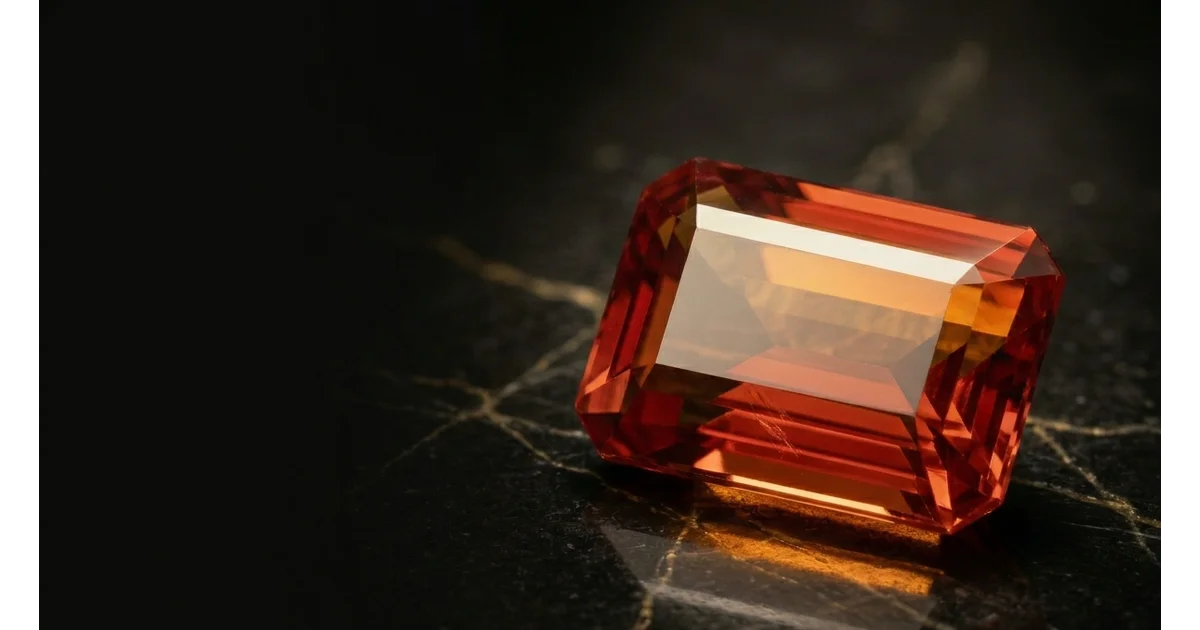
Discover kyawthuite: the world’s rarest mineral with only one known specimen ever found. Learn about its discovery, chemical properties, formation, and where it’s kept today.
Table of Contents
What Is Kyawthuite?
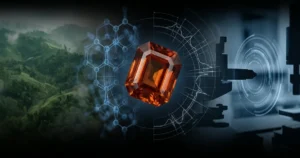
Kyawthuite is officially the rarest mineral on Earth. Of the more than 6,000 minerals recognized by the International Mineralogical Association (IMA), kyawthuite stands alone as the only one known from a single specimen a tiny, reddish-orange gem weighing just 1.61 carats (0.3 grams).
Chemical nature
Its chemical formula is Bi³⁺Sb⁵⁺O₄, a natural bismuth antimonate , making it the only approved bismuth-antimony oxide miner found in nature. The sole specimen currently resides at the Natural History Museum of Los Angeles County, where it is considered priceless.
How Is Kyawthuite Pronounced?
Kyawthuite is pronounced “cha-too-ite.” The name can be tricky at first glance, so this is often one of the first questions people ask when they encounter the mineral for the first time.
The Discovery of Kyawthuite
Found in Myanmar’s “Valley of Rubies”
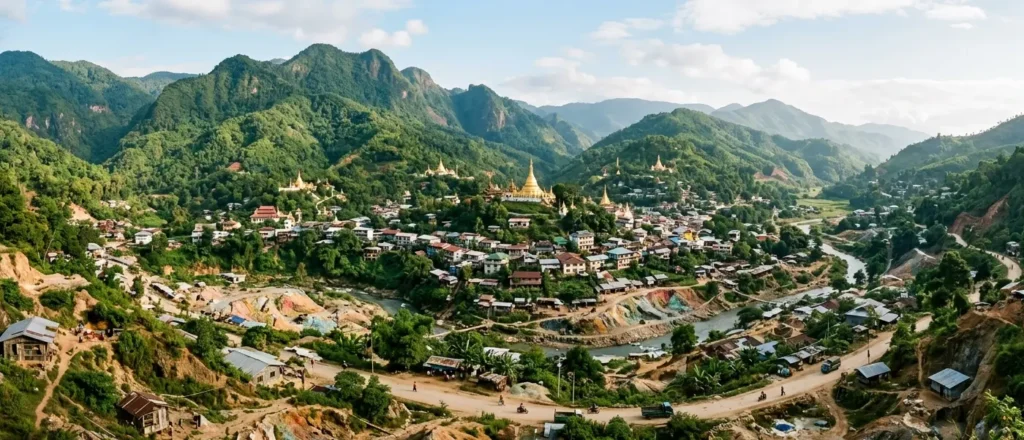
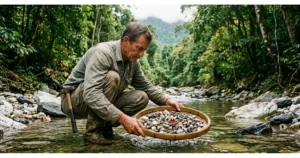
The story of kyawthuite begins in 2010 in the Mogok region of Myanmar, a famed gem-hunting area often called the “Valley of Rubies.” Sapphire hunters working in a local stream bed came across the rough crystal and initially dismissed it as amber or common topaz.
The stone eventually made its way to the Chaung-gyi market in Mogok, where it caught the eye of Dr. Kyaw Thu, a Burmese mineralogist, petrologist, and gemologist with a Ph.D. from Yangon University. He had a feeling the stone was something unusual.
The Road to Official Recognition
After purchasing the specimen and having it faceted, Dr. Kyaw Thu found he could not match it to any known mineral. He sent it to the Gemological Institute of America (GIA) Laboratory in Bangkok, where mineralogists linked it to the synthetic compound BiSbO₄, bismuth antimonate but confirmed that this particular arrangement (Bi³⁺Sb⁵⁺O₄) had never before been documented in nature.
In December 2015, the International Mineralogical Association officially recognized kyawthuite as a new mineral species. Its full scientific description was subsequently published in 2017. Following the tradition in mineralogy of honoring significant contributors, the mineral was named after Dr. Kyaw Thu himself.
Physical Properties of Kyawthuite
One of the most striking physical facts about kyawthuite is its extraordinary density, approximately eight times that of water, and roughly twice as dense as ruby. Its transparent reddish-orange color gives it a gem-like appearance that makes it easy to see why it was initially mistaken for a common gemstone.
Kyawthuite also contains trace amounts of tantalum, titanium, niobium, tungsten, and uranium, elements consistent with formation in pegmatite rock.
Features of kyawthuite
| Property | Value |
|---|---|
| Official Name | Kyawthuite |
| Chemical Formula | Bi³⁺Sb⁵⁺O₄ |
| Crystal System | Monoclinic (space group I2/c) |
| Color | Reddish-orange |
| Transparency | Transparent |
| Streak | White |
| Density | ~8× the density of water (double that of ruby) |
| Hardness (Mohs) | ~5.5–6.5 |
| Weight (sole specimen) | 1.61 carats (0.3 grams) |
| Luster | Submetallic to adamantine |
Chemical Composition and Structure
- Kyawthuite is a bismuth antimonate
- Bismuth carries an oxidation state of +3
- Antimony carries an oxidation state of +5.
- It is isostructural with clinocervantite (its trivalent-antimony analogue)
- It is considered the antimony analogue of clinobisvanite (BiVO₄).
Its internal atomic structure features alternating layers of antimony and oxygen, interspersed with bismuth atoms. Hollow inclusions called “veins en echelon” found within the specimen provide further evidence of its natural formation under extreme pressure and temperature conditions.
How Was Kyawthuite Formed?
The Role of Geology
Kyawthuite is thought to have crystallized in pegmatite, a coarse-grained igneous rock that forms during the final stages of magma cooling. Laboratory experiments have confirmed that bismuth antimonite crystals form at high temperatures consistent with cooling magma environments.
Myanmar’s remarkable geological history is what made this formation possible. Roughly 50 million years ago, during the Paleocene-Eocene epoch, the Indian subcontinent collided with the Asian continent, producing the Himalayan mountain chain and generating extraordinary heat and pressure deep in the Earth’s crust. This tectonic upheaval created the perfect conditions for rare and complex minerals to crystallize.
Why Is It So Rare?
Here is the puzzle: bismuth and antimony are rare metals, but not extraordinarily so. There is actually more bismuth in the Earth’s crust than gold, and antimony is more abundant than silver. So why does kyawthuite exist in only one known specimen?
The answer likely lies not in the scarcity of its ingredients, but in the extreme precision of conditions required for those ingredients to come together in this exact arrangement. The specific temperature, pressure, chemistry, and timing would have to align in a way that apparently happened only once, or at least has only ever been found once in the geological record.
Scientists acknowledge there could be other kyawthuite crystals buried somewhere in the Earth, undiscovered. Decades of conflict, political instability, and international sanctions in Myanmar have severely limited the scientific exploration of the region.
The Mogok Region: Myanmar’s Gemstone Heartland
Mogok is one of the world’s most famous gem-producing regions, renowned for centuries for its exceptional rubies, sapphires, spinel, tourmaline, chrysolite, and peridot. The collision of tectonic plates that created the Himalayas endowed this region with a unique combination of geological conditions, making it a hotspot for rare and unusual minerals.
Myanmar is also the source of painite, long considered the world’s second-rarest mineral, which can be valued at $50,000–$60,000 per carat. That kyawthuite, classified as priceless, also comes from this same region is a testament to how geologically extraordinary the Mogok area truly is.
An Important Ethical Note
Myanmar’s mineral wealth comes with a sobering backdrop. Decades of political instability and military rule have cast a shadow over the country’s gemstone trade. Following the expiration of official mining licenses in 2020 and a military coup in 2021, gemstone mining in Mogok has expanded through informal, largely unregulated channels. Unsafe conditions, forced labor, and exploitation of miners have drawn widespread international concern. Some organizations and buyers have chosen to boycott materials sourced from Myanmar in response.
Where Is Kyawthuite Today?
The world’s only known specimen of kyawthuite is on permanent display at the Natural History Museum of Los Angeles County (LACMA’s NHM) in Los Angeles, California. The museum has described it as one of the most extraordinary additions to its gem and mineral collection.

Because there is only one specimen and it is classified as priceless, kyawthuite is not available for purchase, trade, or commercial use in any form. A nearly identical synthetic compound (BiSbO₄) does exist and can be produced in a laboratory, but the naturally occurring mineral is, for all practical purposes, irreplaceable.
Kyawthuite occupies a category entirely its own. While other extremely rare gems are valued in tens or hundreds of thousands of dollars per carat, the singularity of kyawthuite places it beyond any conventional pricing framework.
Kyawthuite vs. Other Rare Minerals
| Mineral | Number of Specimens | Estimated Value |
| Kyawthuite | 1 | Priceless |
| Painite | Handful | $50,000–$60,000/carat |
| Alexandrite (fine) | Very rare | $70,000+/carat |
| Red Diamond | Extremely rare | $1,000,000+/carat |
Frequently Asked Questions About Kyawthuite
Can you buy kyawthuite?
No. The only known specimen is housed in a museum and is considered priceless. It is not for sale, and no other natural specimens exist to purchase.
Is kyawthuite a gemstone or a mineral?
It is technically both. Kyawthuite is classified as a mineral based on its chemistry and crystal structure, but because it has been faceted and exhibits gem-like optical properties, it is also considered a gemstone in the broader sense.
Why is kyawthuite so rare?
Its constituent elements (bismuth, antimony, and oxygen) are not extraordinarily rare on their own, but the exact geological conditions required to combine them into the BiSbO₄ structure appear to have occurred only once, or at least only one specimen has ever been discovered.
Is there a synthetic version of kyawthuite?

Yes. The synthetic compound BiSbO₄ was already known to scientists before kyawthuite’s discovery, which actually helped them identify the natural specimen. Synthetic kyawthuite can be produced in a laboratory setting, but it holds far less scientific and historical significance than the natural mineral.
What does kyawthuite look like?
The specimen is a transparent, reddish-orange faceted gem. On first glance, it resembles amber or topaz, which is why sapphire hunters initially overlooked it when it was first discovered.
Key Takeaways
Kyawthuite is more than just the world’s rarest mineral, it is a geological mystery, a window into the extraordinary forces that shaped Myanmar’s landscape, and a reminder that Earth still holds secrets we are only beginning to understand. With a single specimen weighing a fraction of a gram, it represents the ultimate extreme of mineral rarity.
Whether you are a gemologist, a geology enthusiast, or simply someone fascinated by the natural world, kyawthuite captures the imagination precisely because of its singularity. There is only one. And it sits, quietly, in a museum in Los Angeles, the sole witness to a geological event that may never be replicated.
Sources:
International Mineralogical Association; Natural History Museum of Los Angeles County; Mineralogical Magazine (Kampf et al., 2017); Caltech Mineral Database.

Nice post. I was checking continuously this blog and I’m impressed!
Extremely helpful info particularly the last part 🙂 I
care for such info a lot. I was looking for this certain information for
a long time. Thank you and good luck.
Pingback: Undiscovered Minerals: Could Earth Still Hide Unknown Species? - KYAWTHUITE