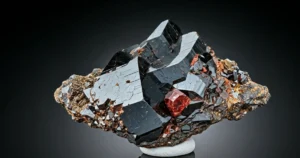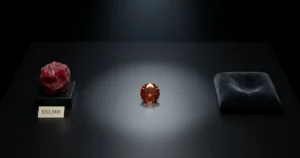

Kyawthuite is famous for one extraordinary reason; only a single confirmed specimen has ever been discovered. This unique status has earned it recognition as the world’s rarest mineral. Yet despite being officially described in 2015, the scientific story of kyawthuite is far from complete.
Table of Contents
Introduction future of kyawthuite research
Researchers know its chemical composition. They know its crystal structure. They know it originated from Myanmar’s renowned Mogok region. However, many of the most important geological questions remain unanswered.
- Why did kyawthuite form?
- Why has only one specimen been found?
- What unique geological conditions produced it?
- Could additional specimens still exist undiscovered?
These questions are driving a growing body of research that may reshape our understanding of not only kyawthuite but also the processes that create Earth’s rarest minerals.
Why Kyawthuite Remains a Scientific Mystery
Most mineral species are represented by dozens, hundreds, or even thousands of specimens. Scientists can compare samples from different locations and geological environments to understand how a mineral forms. Kyawthuite presents a completely different challenge. The entire scientific understanding of the mineral is based on a single crystal weighing approximately 1.61 carats.
This creates a major limitation:
- Only one sample exists
- The specimen is extremely small
- Researchers must preserve it for future generations
- Many traditional laboratory methods would damage or destroy the sample
As a result, scientists must carefully balance research goals with conservation. The rarity that makes kyawthuite fascinating is also what makes it difficult to study.
The Challenge of Studying a Single Specimen
Modern mineralogical research often relies on techniques that require removing material from a specimen.
Examples include:
- Bulk chemical analysis
- Powder X-ray diffraction
- Laser ablation studies
- Transmission electron microscopy
- Destructive isotopic measurements
For common minerals, sacrificing a small amount of material is routine. For kyawthuite, even microscopic damage is significant because there is no replacement specimen.
This limitation has encouraged researchers to develop and adopt highly sensitive non-destructive analytical techniques capable of extracting maximum scientific information without harming the mineral.
Synchrotron X-Ray Studies: Seeing Atoms in Greater Detail
- One of the most promising avenues for future kyawthuite research involves synchrotron radiation.
- A synchrotron is a large particle accelerator that generates exceptionally powerful X-rays.
- These intense X-ray beams allow scientists to examine crystal structures at extraordinary levels of precision.
What Could Synchrotron Studies Reveal?
Future synchrotron investigations could help researchers:
- Measure atomic bond lengths more accurately
- Detect subtle crystal distortions
- Identify structural defects
- Compare natural and synthetic BiSbO₄ structures
- Understand the conditions under which kyawthuite formed
- Because synchrotron techniques are non-destructive, they offer one of the safest ways to gain new information from the only known specimen.
Isotopic Analysis: Reading the Mineral’s Geological Fingerprint
Every mineral carries a chemical record of its formation environment. One of the most powerful tools for decoding that record is isotopic geochemistry. Different isotopes behave slightly differently during geological processes, creating measurable signatures that reveal information about:
- Formation temperatures
- Fluid chemistry
- Source rocks
- Geological age
- Hydrothermal activity
Key Isotopes Scientists Want to Study
Oxygen Isotopes (δ18O)
These isotopes can help estimate:
- Crystallization temperatures
- Water sources
- Hydrothermal fluid evolution
Antimony Isotopes
Because kyawthuite contains antimony, isotope ratios may reveal:
- Elemental provenance
- Source fluid pathways
- Geochemical fractionation processes
Lead Isotopes
Trace lead could potentially provide clues about:
- Geological age
- Magmatic sources
- Regional tectonic history
The challenge is that isotopic measurements usually require small amounts of material, making such studies difficult on a one-of-a-kind specimen.
Raman Spectroscopy and Spectral Fingerprinting
Raman spectroscopy has become one of the most valuable tools in modern mineral identification. The technique uses laser light to measure how atoms vibrate within a crystal structure. Each mineral produces a unique spectral signature, often referred to as a fingerprint.
Why Raman Data Matters
Creating a definitive Raman fingerprint for kyawthuite would:
- Improve mineral identification
- Expand global spectral databases
- Enable AI-based classification
- Assist museums and laboratories worldwide
A high-quality reference spectrum could become one of the most important resources for discovering additional specimens.
AI Is Transforming Rare Mineral Discovery
Artificial intelligence is rapidly becoming a powerful tool in mineralogy. Machine-learning systems can analyze thousands of spectra, chemical datasets, and mineral records far faster than humans. For an ultra-rare mineral like kyawthuite, AI may prove especially valuable.
Potential AI Applications
Future AI systems could:
- Identify overlooked museum specimens
- Analyze Raman spectra automatically
- Flag unusual Bi-Sb oxide minerals
- Detect patterns invisible to human researchers
- Improve field-based mineral identification
As global mineral databases continue expanding, AI may become one of the best tools for finding another kyawthuite specimen.
Museum Collection Surveys: The Most Likely Place to Find a Second Specimen
Many mineralogists believe that the most realistic short-term path to discovering another kyawthuite may not involve new mining operations. Instead, the answer could already be sitting in a museum drawer. Natural history museums collectively house millions of mineral specimens collected over centuries. Many were classified decades before modern analytical methods became available.

Why Misidentification Happens
Historically, mineral identification often relied on:
- Color
- Hardness
- Crystal habit
- Visual inspection
- Basic chemical tests
Rare minerals could easily have been misclassified.
Modern Screening Methods
Researchers can now use:
- Portable X-ray fluorescence (pXRF)
- SEM-EDS analysis
- Raman spectroscopy
- Electron microprobe testing
These methods can rapidly screen collections for unusual bismuth-antimony minerals that may warrant further investigation. A systematic museum survey could potentially uncover a previously overlooked kyawthuite specimen.
The Search for More Kyawthuite in Myanmar
The Mogok Stone Tract in Myanmar remains one of the most mineralogically important regions on Earth. It has produced:
- Rubies
- Sapphires
- Spinels
- Rare oxides
- Exotic mineral species
Kyawthuite originated from this remarkable geological environment.

Future Field Research
Scientists hope to conduct:
- Geological mapping
- Stream sediment surveys
- Pegmatite investigations
- Hydrothermal vein studies
- Geochemical exploration programs
These efforts could identify environments capable of producing additional BiSbO₄ crystals. However, political and logistical challenges currently limit large-scale international scientific access to the region.
Why a Second Kyawthuite Specimen Would Be Revolutionary
The discovery of another kyawthuite specimen would represent one of the most important events in modern mineralogy. Currently, researchers only have one data point. A second specimen would allow direct comparison. Scientists could investigate:
- Trace element concentrations
- Isotopic compositions
- Crystal growth patterns
- Inclusion assemblages
- Formation ages
These comparisons would significantly improve our understanding of the mineral’s origin.
Same Locality vs Different Locality
A second specimen from the same geological area would confirm that kyawthuite formation occurred more than once. A specimen from a completely different location would be even more significant. Such a discovery would demonstrate that the mineral can form under specific but reproducible geological conditions elsewhere on Earth.
Synthetic BiSbO₄ Research and Materials Science
Although natural kyawthuite is exceptionally rare, scientists can synthesize its chemical equivalent in laboratories. Synthetic BiSbO₄ is attracting growing interest because of its potential applications in,
- Photocatalysis
- Environmental remediation
- Water purification
- Solar energy research
- Semiconductor materials
Why This Research Matters
Laboratory studies help scientists understand:
- Crystal growth mechanisms
- Stability conditions
- Electronic properties
- Structural behavior
These insights may ultimately improve our understanding of how natural kyawthuite formed.
Kyawthuite and the Future of Mineral Discovery
The study of kyawthuite reflects a broader transformation occurring within mineralogy. Researchers increasingly recognize that extremely rare minerals may represent previously overlooked geological processes rather than simple curiosities. Today, the International Mineralogical Association recognizes more than 6,000 mineral species. Scientists estimate that many more remain undiscovered.The tools being developed to study kyawthuite are also helping researchers identify future mineral discoveries. These include:
- AI-assisted identification
- Advanced spectroscopy
- Portable analytical instruments
- Digital mineral databases
- Large-scale collection surveys
What Scientists Hope to Learn by 2027
Several key objectives are likely to guide future research efforts:
- Produce higher-resolution structural models.
- Expand Raman spectral databases.
- Investigate isotopic formation signatures.
- Survey museum collections worldwide.
- Improve AI-assisted mineral identification.
- Conduct targeted Mogok field studies.
- Discover additional specimens.
Achieving even a few of these goals would significantly improve our understanding of Earth’s rarest mineral.
Conclusion
Kyawthuite remains one of the most intriguing mysteries in mineralogy. Although scientists have determined its chemical composition and crystal structure, many fundamental questions about its origin and rarity remain unanswered. Future research will rely heavily on advanced non-destructive technologies, AI-assisted mineral identification, museum collection surveys, and geological exploration in Myanmar. Every new piece of evidence helps researchers move closer to understanding how this extraordinary mineral formed.
Yet the most exciting possibility remains unchanged: the discovery of a second specimen..
FAQs
Will more kyawthuite be found?
Possibly. Scientists believe additional specimens may exist in museum collections, private collections, or unexplored parts of Myanmar’s Mogok region, but none have been confirmed.
What research is currently being conducted on kyawthuite?
Researchers are focusing on synchrotron X-ray studies, Raman spectroscopy, isotopic analysis, AI-assisted mineral identification, and museum collection surveys.
Why is kyawthuite difficult to study?
Only one specimen exists, and scientists must avoid damaging it. This limits the use of many traditional analytical methods.
What would a second kyawthuite specimen reveal?
A second specimen would allow comparisons of chemistry, isotopes, crystal structure, and geological origin, dramatically improving scientific understanding of the mineral.
Can kyawthuite be synthesized in a laboratory?
Yes. Scientists can produce synthetic BiSbO₄, which is chemically equivalent to kyawthuite and is being studied for photocatalytic and environmental applications.
Is kyawthuite still the world’s rarest mineral?
Yes. As of 2026, kyawthuite remains the rarest known mineral species because only one confirmed natural specimen has been identified.