Why you cannot buy kyawthuite? How much is kyawthuite cost? Is kyawthuite for sale anywhere? The blunt answers are no and no and any listing that says otherwise is fraud. This article explains why, identifies common substitute minerals, and tells you exactly how to protect yourself.
Introduction to kyawthuite Fraud, Fakes, Replicas and Pricing
Why you cannot buy kyawthuite? How much is kyawthuite cost? Any mineral that becomes famous for its extreme rarity becomes, almost immediately, a target for misrepresentation. Kyawthuite the world’s only single-specimen mineral presents a fraud landscape so straightforward it almost defies description: the only specimen is in a museum, it is not for sale, and therefore every commercial listing claiming to offer kyawthuite is false. This is not a nuanced judgment or a matter of opinion. It is a logical certainty. Yet listings have appeared. Confusion has spread. People have asked “where can I buy kyawthuite?” and “how much does kyawthuite cost?” “how much is kyawthuite worth?” in good faith, not knowing that both questions are unanswerable by design. Understanding why kyawthuite cannot be purchased and how fraudsters exploit the confusion is essential for any collector, enthusiast, or curious buyer navigating the rare mineral marketplace.
How much is kyawthuite cost?
Any listing on any platform, at any price claiming to sell “kyawthuite,” “natural kyawthuite crystal,” “raw kyawthuite specimen,” or any variation thereof is categorically fraudulent. The only authentic specimen is permanently housed at the NHM Los Angeles and is not commercially available under any circumstances whatsoever. Zero exceptions exist.
The Logical Structure of the Fraud
There is only one known kyawthuite specimen in the world. It weighs 1.61 carats and measures 5.8 × 4.58 × 3 mm. It is the property of the Natural History Museum of Los Angeles County, which has no record of selling it and no intention of doing so. Any stone offered for sale as “kyawthuite” falls into one of three categories:
- A different mineral being fraudulently labeled as kyawthuite;
- A synthetic BiSbO₄ material being represented as the natural rarity; or
- A glass or resin imitation.
In categories (2) and (3), if the seller is transparent that the item is synthetic or a replica, no fraud is committed. It is the pretense of natural origin and genuine rarity that constitutes fraud.
Common Substitute Minerals Used in Kyawthuite Fraud
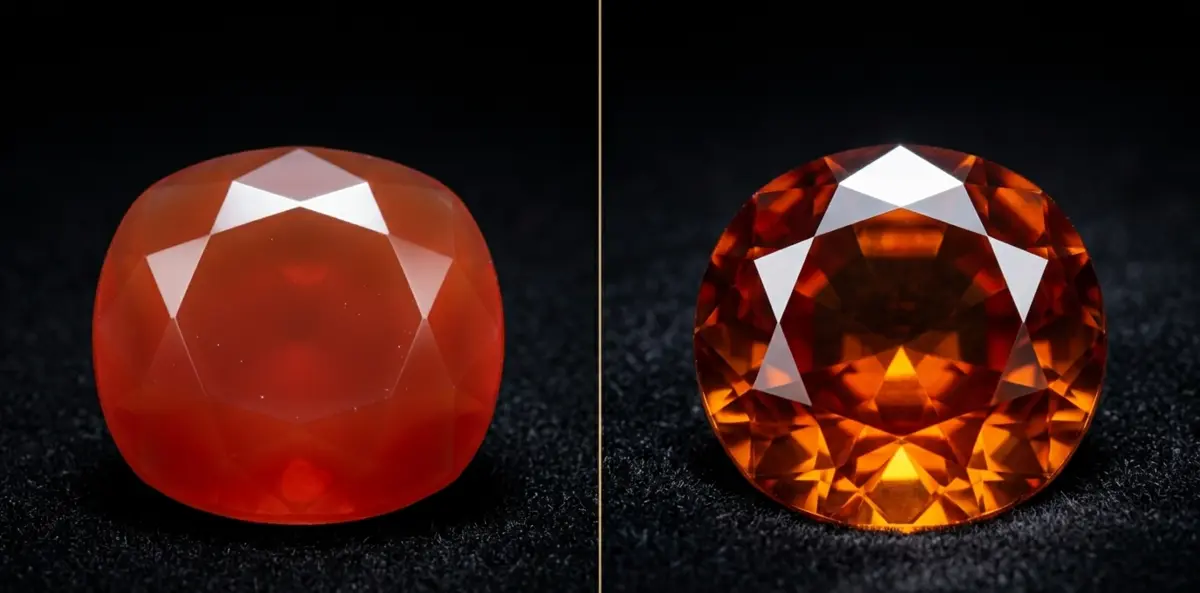
Several orange to amber-colored minerals superficially resemble kyawthuite’s color and translucency. Without analytical testing, these stones can be and are sold deceptively to buyers who associate “orange translucent stone from Myanmar” with kyawthuite:
| Substitute Mineral | Appearance | How It Differs from Kyawthuite | Market Price |
| Hessonite Garnet | Orange to honey-brown, translucent | Silicate mineral (Ca₃Al₂Si₃O₁₂), lower density, fluorescent | $10–$200/ct |
| Golden Topaz | Amber-yellow to orange, transparent | Silicate (Al₂SiO₄F₂), hardness 8, much lower density | $50–$500/ct |
| Orange Zircon | Vivid orange, high refractive index | Silicate (ZrSiO₄), tetragonal, UV fluorescence | $100–$800/ct |
| Imperial Spessartine | Deep orange, vivid saturation | Garnet group, Mn₃Al₂Si₃O₁₂, hardness 7.5 | $500–$2,000/ct |
| Orange Tourmaline | Orange to brownish, transparent | Complex borosilicate, trigonal crystal system | $300–$1,500/ct |
| Orange Sapphire | Padparadscha-range orange | Corundum (Al₂O₃), hardness 9, much rarer but multiple specimens | $1,000–$10,000/ct |
The Synthetic Fraud Vector
Synthetic BiSbO₄ is chemically identical to natural kyawthuite and can be produced in laboratory settings. A sophisticated fraud could involve presenting synthetic material or even natural synthetic-BiSbO₄ from a materials science supplier as “genuine natural kyawthuite from Mogok.” Detecting this fraud would require isotopic analysis and detailed inclusion studies beyond the capabilities of most standard gem testing laboratories. This fraud vector is currently more theoretical than prevalent, but as kyawthuite’s fame grows in online mineral communities, the economic incentive to exploit the confusion will grow with it.
Legitimate Replicas and What They Are
It is worth distinguishing fraudulent misrepresentation from legitimate replicas. Educational institutions, gem museums, and science communicators occasionally commission glass, resin, or synthetic replica models of famous specimens for handling demonstrations and educational displays. If such an item is clearly labeled as a replica “synthetic replica of the kyawthuite specimen,” for example and is not priced or described in a way that implies natural origin, no fraud is committed. The issue arises exclusively when replicas, substitutes, or synthetic material is presented deceptively as the genuine natural mineral.
Collector Tip
No legitimate dealer not at Tucson, not at the Munich Mineral Show, not on established platforms like Mindat or Gem Rock Auctions, not at any auction house will ever offer kyawthuite for sale. If someone at any of these venues claims to have kyawthuite, ask Kyawthuite: The World’s Rarest Mineral Complete Guidethem for their IMA certification, the chain of custody from the NHM, and the peer-reviewed mineral description. The absence of all three confirms fraud.
How to Protect Yourself: A Practical Checklist
Apply the Basic Logic Test
The only specimen is in a museum. No legitimate chain of custody leads from the NHM to a commercial sale. This fact alone is sufficient to reject any offer. No further analysis is needed.
Request GIA or Equivalent Certification
For any rare mineral purchase, demand a certificate from a credentialed gemological institution (GIA, AGL, Gübelin, SSEF, etc.) that identifies the stone’s chemical composition, crystal structure, and geographic origin by modern analytical methods.
Verify Any “New Specimen” Claim
If a seller claims to have a “newly discovered” second kyawthuite specimen, this would be global mineralogical news published in peer-reviewed journals. IMA approval is public record. If no such publication exists, the claim is false.
Report Fraudulent Listings
Listings claiming to sell kyawthuite on platforms like eBay, Etsy, or social media can be reported for fraud. Doing so protects other buyers and reduces the economic incentive for continued deception.
Fraud & Purchase FAQsKyawthuite: The World’s Rarest Mineral Complete GuideKyawthuite: The World’s Rarest Mineral Complete Guide
Why you cannot buy kyawthuite
Kyawthuite is not for sale anywhere, by anyone, at any price. The only specimen is permanently housed at the Natural History Museum of Los Angeles County and is not a commercial item. Any seller claiming to offer kyawthuite is committing fraud. There is no legitimate market for this mineral and no authorized commercial source
Can I buy a kyawthuite ring?
No genuine kyawthuite ring exists or can exist, since the only specimen is a museum artifact. Any jewelry piece marketed as containing “kyawthuite” is either using a substitute mineral or a synthetic replica, and must be evaluated accordingly. A legitimate jeweler would describe what the stone actually is rather than misrepresenting it as kyawthuite.
Is there a rare mineral specimen for sale similar to kyawthuite?
Yes, painite is the closest legitimate commercially available rare mineral in the same rarity tier. Authentic certified painite from Myanmar is sold through specialist dealers at $50,000–$60,000 per carat. Musgravite ($35,000/ct), grandidierite ($20,000/ct), and alexandrite ($12,000/ct) are other extremely rare minerals that can be legitimately purchased. Always verify with a GIA or equivalent lab certificate.