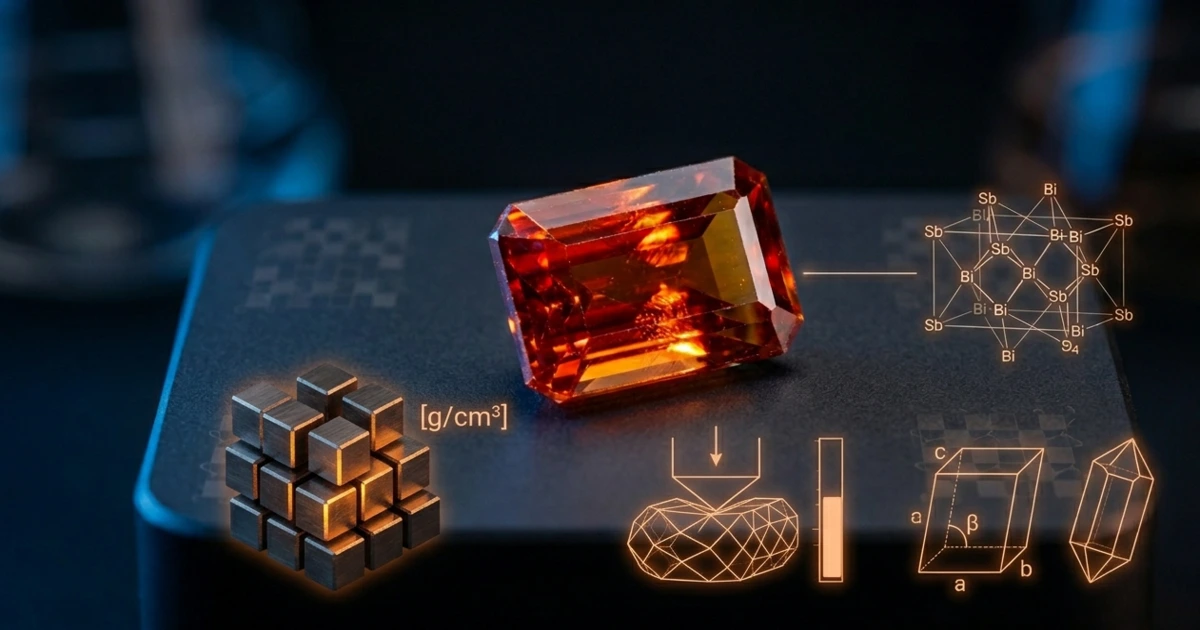
Complete kyawthuite properties breakdown. What is kyawthuite made of? How hard is it? What does the kyawthuite crystal look like under a microscope? This comprehensive properties breakdown covers every confirmed physical, chemical, optical, and structural characteristic of the world’s rarest mineral
Table of Contents
Intoduction
Every physical and chemical property of kyawthuite tells a story about how it formed, what conditions it survived, and why it looks and behaves the way it does. Given that the world’s entire supply of kyawthuite fits on a fingertip and weighs just 0.3 grams, extracting and documenting those properties required extraordinary precision. Modern microanalytical tools made it possible. The result is a surprisingly complete scientific portrait of the rarest mineral on Earth.
What Is Kyawthuite Made Of?
Chemical Composition
Kyawthuite chemical formula: Bi³⁺Sb⁵⁺O₄.
One atom of bismuth (Bi) in the +3 oxidation state,
One atom of antimony (Sb) in the +5 oxidation state,
and four atoms of oxygen (O).
The naming convention Bi³⁺Sb⁵⁺O₄, rather than simply BiSbO₄, specifies the oxidation states of both metal atoms, which is crucial to understanding the mineral’s structure and distinguishing it from theoretical variants where bismuth or antimony might occupy different charge states.
Trace element
In addition to the primary bismuth-antimony-oxygen framework, electron probe analysis has detected trace elements including tantalum (Ta), titanium (Ti), niobium (Nb), tungsten (W), and uranium (U). These trace elements are geochemically diagnostic: their presence is consistent with formation in a pegmatite environment, where late-stage magmatic fluids concentrate rare and heavy elements into unusual mineral assemblages. The trace element signature is one of several lines of evidence pointing to kyawthuite’s pegmatitic origin.
Key Chemical Insight
Kyawthuite is notable for being the only known naturally occurring bismuth-antimony oxide mineral. It is a chemical analogue of clinobisvanite (BiVO₄), but with antimony replacing vanadium, a sbstitution that produces significantly different structural and optical properties. It is not analogous to bismutotantalite or bismutocolumbite, which are structurally distinct families.
Complete Kyawthuite Physical & Chemical Properties
Chemical Formula: Bi³⁺Sb⁵⁺O₄ (+ trace Ta, Ti, Nb, W, U)
Mineral Class: Oxide mineral (Bi-Sb oxide)
Crystal System: Monoclinic
Space Group: I2/c Isostructural With Clinocervantite (SbSbO₄)
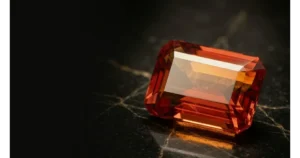
Color: Deep reddish-orange to amber-brown
Transparency: Transparent to translucent
Luster: Adamantine (diamond-like) to submetallic
Streak: White / pale yellowish-white
Hardness: (Mohs Scale)5.5
Specific Gravity: 8.256 (approximately 8× density of water)
Refractive Index: 1.9 – 2.5 (very high)
Fracture: Conchoidal (shell-like)
Fluorescence: (UV)Non-fluorescent
Weight of Specimen: 1.61 carats (0.3 grams)
Dimensions: 5.8 × 4.58 × 3 mm
Formation Type: Pegmatite (igneous-related)
IMA Status: Approved – IMA 2015-017
Crystal Structure;
What the Kyawthuite Crystal Looks Like Inside?
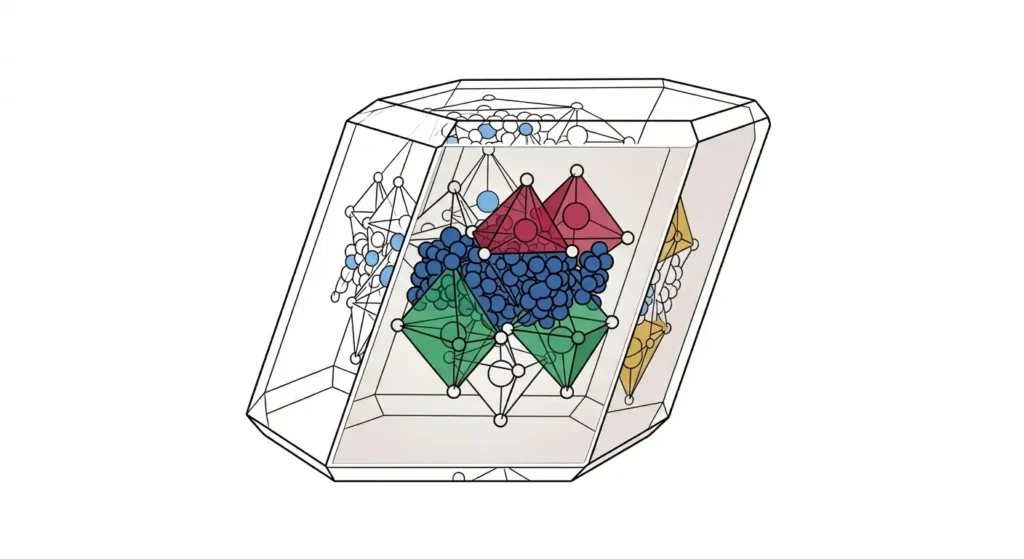
The kyawthuite crystal belongs to the monoclinic crystal system , one of the seven crystal systems into which all minerals are classified. A monoclinic crystal has three unequal axes, two of which intersect at an oblique angle (not 90°), giving the crystal form a characteristic parallelogram-prism shape when fully developed. Kyawthuite’s specific space group is I2/c, which describes the precise symmetry operations of its internal atomic arrangement.
Structural Relationship;
The mineral is isostructural with clinocervantite (SbSbO₄), meaning it shares the same three-dimensional framework but with bismuth occupying positions that antimony fills in clinocervantite. This structural relationship helped scientists understand and model kyawthuite’s properties quickly, despite having only a single tiny specimen to work with. The mineral also exhibits hollow inclusions described as “veins en echelon,” which are characteristic of formation under tectonic stress and are further evidence of a natural geological origin.
Color of kyawthuite.
Why Is Kyawthuite Orange?
One of the most immediately striking features of kyawthuite is its color. The mineral ranges from deep reddish-orange to amber-brown, with the exact shade varying slightly depending on lighting conditions. This warm, vivid coloration is not a superficial coating or impurity-driven phenomenon, it is intrinsic to the mineral’s chemical structure.
Reasons to its color;
Bismuth compounds are well-known in chemistry for producing intense yellows, oranges, and reds. Bismuth vanadate (BiVO₄), for example, is used as a high-performance yellow pigment in industrial paints. In kyawthuite, the electronic charge-transfer transitions between Bi³⁺ and O²⁻ ions absorb shorter wavelengths of the visible spectrum (blues and violets), allowing the longer wavelengths, reds and oranges to dominate the transmitted light. The result is the characteristic warm, amber-to-reddish-orange hue that makes kyawthuite simultaneously beautiful and scientifically distinctive.
Color makes kyawthuite overlook first in Mogok valley;
This coloration is one reason why kyawthuite was initially overlooked in the gem market. Orange-colored minerals are common in Myanmar’s gem trade, hessonite garnet, golden topaz, orange tourmaline, and amber-toned zircon all produce similar hues to casual inspection. Without analytical testing, kyawthuite’s color alone would not flag it as unique.
Hardness of kyawthuite.
Is Kyawthuite Hard Enough to Be a Gemstone?
Kyawthuite registers 5.5 on the Mohs hardness scale, the standard 1–10 scale used to measure a mineral’s scratch resistance, where talc is 1 and diamond is 10. At 5.5, kyawthuite is moderately hard: it can scratch materials like apatite (hardness 5) and calcite (hardness 3), but is softer than quartz (hardness 7) and significantly softer than diamond (hardness 10).
For gemological purposes, 5.5 is generally considered below the ideal threshold for durable everyday wear most gemstones used in jewelry rank 7 or above to resist scratching from common dust and quartz particles in the environment. Kyawthuite’s hardness means it would not be well-suited for use in rings or bracelets if it were not already categorically off-limits as the world’s only specimen.
The mineral also exhibits a conchoidal fracture, meaning it breaks with smooth, curved surfaces resembling the inside of a shell, and is described as brittle. This brittleness, combined with moderate hardness, reinforces the conclusion that kyawthuite, even if multiple specimens existed, would be a challenging mineral to work with in a jewelry setting.
Density of kyawthuite.
What is the Weight of kyawthuite?
With a specific gravity of 8.256, kyawthuite is exceptionally dense approximately 8.25 times heavier than an equal volume of water. This remarkable density is primarily due to bismuth, which has an atomic mass of approximately 209 g/mol, making it one of the heaviest naturally occurring non-radioactive elements. For context, quartz has a specific gravity of 2.65, diamond is 3.5, and pure iron is 7.87. Kyawthuite is denser than iron.
For the 1.61-carat specimen, this means the physical volume is surprisingly small: the stone measures only 5.8 × 4.58 × 3 millimeters smaller than a typical shirt button yet contains a meaningful mass.
High density is a practical diagnostic property: a field geologist holding an orange stone of unexpectedly high weight for its size might suspect a bismuth-rich composition.
Optical Properties.
Luster and Refractive Index
Kyawthuite exhibits an adamantine luster, the brilliant, high-gloss surface sheen associated with minerals of very high refractive index. The term “adamantine” is derived from the Greek for “diamond-like,” and reflects the intense surface reflectivity produced when light interacts with a material that bends it strongly. Kyawthuite’s refractive index (RI) ranges from 1.9 to 2.5, an unusually wide and high range. For comparison, diamond has an RI of 2.42, which is what gives it its famous brilliance. Kyawthuite’s refractive index overlaps with diamond’s at its upper range, which means that under proper lighting, the specimen can display a similarly intense surface brilliance. Combined with its vivid orange-to-red coloration, this optical profile makes kyawthuite genuinely beautiful, an aesthetic fact that is easy to overlook in the shadow of its scientific significance.
Importantly, kyawthuite shows no fluorescence under ultraviolet (UV) light. UV fluorescence is a commonly used diagnostic tool in gemology and mineralogy, many minerals glow distinctive colors under UV. Kyawthuite’s non-fluorescence under both short-wave and long-wave UV provides a straightforward diagnostic data point that, combined with its other properties, helps confirm its identity.
Formation Environment.
Kyawthuite a Pegmatite Product
Multiple lines of evidence point to kyawthuite having formed in a pegmatite environment, a type of coarse-grained igneous rock that crystallizes during the late stages of magma cooling, when residual magmatic fluids are highly concentrated in rare, heavy, and chemically unusual elements. The trace element suite (tantalum, niobium, tungsten, uranium, titanium) is a classic pegmatitic fingerprint. Laboratory experiments on synthetic bismuth antimonite crystals show they form at high temperatures consistent with cooling magma or late-stage hydrothermal fluids in a pegmatite setting. The mineral’s intricate atomic structure, the checkerboard Sb-O sheets, the en echelon inclusions, further suggests crystallization under the elevated pressures characteristic of deep crustal or pegmatitic environments.
“Every property of kyawthuite, its density, its color, its refractive index, its trace elements tells a story about a single geological moment. Reading those properties is like reading the autobiography of a formation event that will never be repeated.”
Available Carat Weight of kyawthuite and Specimen Completeness
The entire available mass of kyawthuite in existence is 1.61 carats, one specimen, faceted into a gemstone form for scientific study. The faceting was performed to optimize the specimen for optical and spectroscopic analysis, not for aesthetic display (though the result is both scientifically useful and visually appealing).
The stone’s small size presents an inherent limitation: many analytical techniques that would yield valuable data isotopic analysis, detailed inclusion study, neutron diffraction, cannot be applied without damaging or destroying some portion of the specimen. Scientists must work within severe constraints imposed by the specimen’s irreplaceability.
As analytical techniques become less destructive and more sensitive, the range of possible studies expands slightly, but kyawthuite will always be, in a practical sense, a protected artifact as much as a scientific sample.
About Kyawthuite chemical properties frequently asked question?
What is kyawthuite made of?
Kyawthuite is made of bismuth, antimony, and oxygen in the chemical formula Bi³⁺Sb⁵⁺O₄, making it a natural bismuth antimonate oxide. It also contains trace amounts of tantalum, titanium, niobium, tungsten, and uranium a signature consistent with its pegmatite formation environment in Myanmar’s Mogok region.
What color is kyawthuite?
Kyawthuite is a deep reddish-orange to amber-brown color, transparent to translucent in appearance. Its vivid orange coloration is caused by electronic charge-transfer processes involving bismuth ions in its crystal structure. Under good lighting, the adamantine luster gives the stone a brilliant, jewel-like appearance despite its small size.
What is the hardness of kyawthuite?
Kyawthuite has a Mohs hardness of 5.5. This places it in the mid-range on the 1–10 Mohs scale, harder than apatite (5) but softer than quartz (7) and significantly softer than diamond (10). It is classified as brittle and shows conchoidal (shell-like) fracture.
What is the kyawthuite crystal structure?
Kyawthuite has a monoclinic crystal structure with space group I2/c. It is isostructural with clinocervantite, featuring checkerboard-like sheets of Sb⁵⁺O₆ octahedra positioned parallel to bismuth atoms. This distinctive atomic architecture creates a three-dimensional framework that is unique to kyawthuite among all naturally occurring minerals.
What is the available carat of kyawthuite?
The total available carat weight of kyawthuite in the world is 1.61 carats, the entire supply is contained in the single known specimen, housed at the Natural History Museum of Los Angeles County. No additional specimens are available for purchase, study, or collection.