Is kyawthuite rarer than diamond? Before answering this, imagine a gem so rare that all the diamonds ever mined in human history would fill buckets, while the entire global supply of this other mineral would not even fill a thimble. That is the reality of kyawthuite.
Table of Contents
Is kyawthuite rarer than diamond
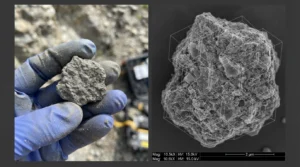
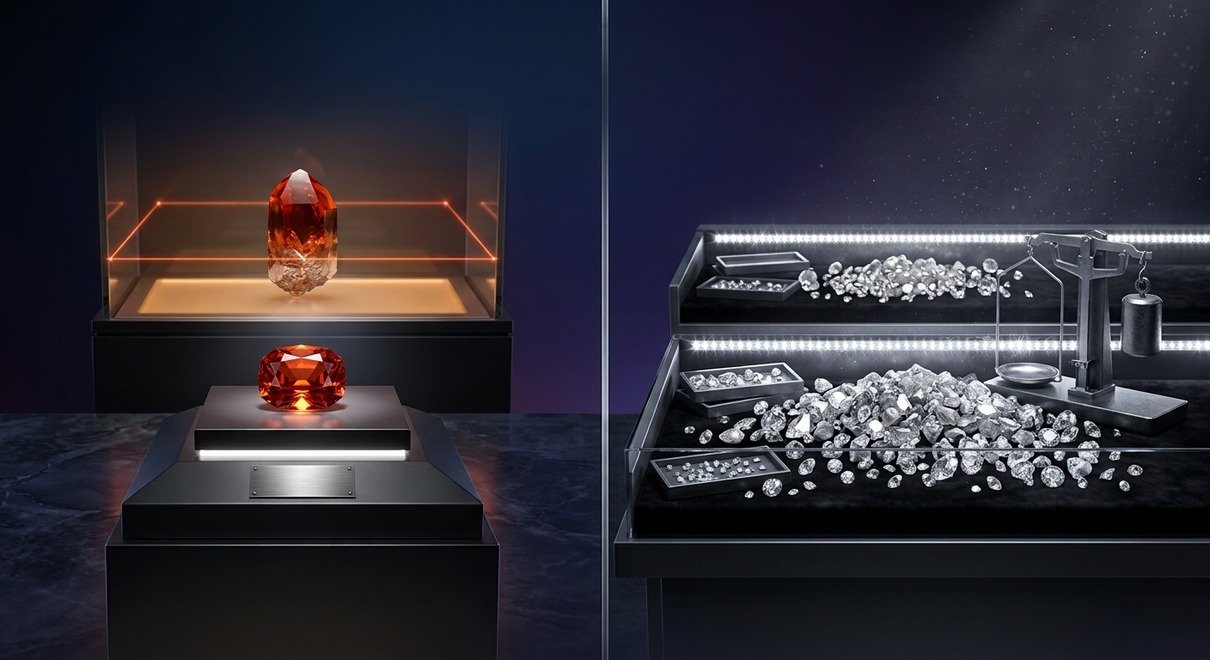
Kyawthuite is much rarer than a diamond, yes. In fact, it’s the rarest mineral ever confirmed on Earth, with precisely one natural specimen known to science. That one crystal, a transparent reddish-orange gem weighing 1.61 carats (about 0.3 grams), was discovered near Mogok, Myanmar, and is now in the Natural History Museum of Los Angeles County. Diamonds, by contrast, are mined on several continents in millions of carats per year. The two are not in the same ballpark as far as natural scarcity goes.
However, Kyawthuite’s tale goes beyond a single figure. It is a window into how minerals form, why rarity is not the same as price, and why one little crystal can teach us more about Earth’s hidden chemistry than a warehouse full of polished diamonds.
What is Kyawthuite?
Kyawthuite is not just a gemstone; it is a mineral species officially recognized by the International Mineralogical Association (IMA). Its chemical formula is BiSbO₄, making it a natural bismuth antimonate. In plain terms, it is a compound of bismuth and antimony oxides, a combination that had never before been observed in nature.
The mineral was discovered in 2010 by miners sifting through river gravel in Myanmar’s Chaung-gyi Valley. They initially thought the water-worn crystal was amber or topaz. A Burmese gemologist, Dr. Kyaw Thu, later purchased it at a local market, faceted it into a 1.61-carat gem, and submitted it for analysis. In 2015, the IMA officially recognized it as a new mineral and named it after him.
Today, the one known specimen is on public display at the Natural History Museum of Los Angeles County, where it remains the only confirmed example of its kind on the planet.
How rare is kyawthuite compared to diamond?
When you look at the numbers, the comparison is practically ridiculous.
Russia, Botswana, Canada, Angola, South Africa, Zimbabwe, and other nations mine diamonds. Global natural diamond output for industrial-grade stones alone reached almost 38 million carats in a single recent year, with millions more coming from gem-quality manufacturing. Every year, almost 16 million carats are produced in Russia alone. Diamonds are so plentiful that they are utilized in abrasives, drill bits, and industrial cutting equipment in addition to jewelry.
Kyawthuite, meanwhile, exists as one single crystal. Not one deposit, not one mine, not one region, not one specimen. Kyawthuite is like a single grain discovered once and never seen again, whereas diamond rarity is like sand grains on numerous beaches.
Even among other famously rare minerals, kyawthuite stands alone. Painite, once called the world’s rarest gem, now has hundreds of known specimens. Kyawthuite has one. That is not a difference of degree; it is a difference of kind.
Why is kyawthuite so rare?
The surprising answer is that its ingredients are not the problem.
Bismuth and antimony are relatively scarce metals, but they are far from the rarest elements in Earth’s crust. There is more bismuth in the crust than gold, and antimony is more abundant than silver. Oxygen is the most common element in the crust. So why does Kyawthuite exist only once?
Formation conditions hold the key to the solution. In alluvium river gravel close to Mogok, Kyawthuite was discovered as a water-worn crystal. Although the original host rock’s composition is unknown, its chemistry indicates that it formed in a very particular geological setting, most likely involving fluids rich in bismuth and antimony interacting with nearby rock under exact temperature and pressure circumstances. Because the circumstances are so rare, it seems that nature has just once in recorded history created a crystal that can withstand erosion and travel.
Mogok, a geological anomaly in northern Myanmar, is well-known for generating a remarkable variety of gemstones, such as ruby, sapphire, spinel, and painite. The precise recipe for kyawthuite has never been duplicated, even in this gem-rich region.
Where do diamonds come from, and how does that affect rarity?
Diamonds form deep in Earth’s mantle, roughly 150 to 250 kilometers below the surface, where carbon is subjected to intense heat and pressure. They are brought to the surface by volcanic eruptions that create kimberlite and lamproite pipes, rock formations that act as elevators for deep mantle material.
These pipes are found on every continent except Europe and Antarctica, and major producing countries include Russia, Botswana, Canada, Angola, South Africa, and Zimbabwe. The scale of diamond mining is industrial: entire open-pit and underground mines operate continuously, processing millions of tons of ore to recover diamonds.
This is the crucial distinction: gem rarity and mineral rarity are not the same thing. A particular diamond color or clarity grade might be a rare, flawless pink diamond, for example, but the mineral species “diamond” is common. Kyawthuite is rare at the species level. It is not that a particular kyawthuite is hard to find; it is that the mineral itself has only been found once.
Painite and other ultra-rare gems
For decades, painite held the title of world’s rarest gemstone. First discovered in Myanmar in the 1950s, only two crystals were known for years, and it was almost considered a myth. But after 2005, gem hunters found more deposits in the Mogok region, and today hundreds of painite specimens are known.
Gem-quality painite is still exceptionally rare and commands prices of $50,000 to $60,000 per carat or more. Lower-grade rough sells for far less, often just dollars per carat. But even at its rarest, painite had multiple specimens and a functioning, if tiny, market.
Kyawthuite goes beyond that. With one specimen, there is no market at all. Painite is the rarest gem you can theoretically buy. Kyawthuite is the rarest mineral you cannot buy at any price because there is nothing to sell.
Does rarity make kyawthuite more valuable than diamond?
Here is where the story takes an unexpected turn: rarity does not automatically equal market value.
Kyawthuite has no established price because there is no market. You cannot buy it, sell it, or trade it. Its value is scientific and institutional, not commercial. The specimen is housed in a museum, and its worth is measured in what it can teach researchers about mineral formation, crystal chemistry, and the geological history of the Mogok region.
Diamonds, by contrast, have a massive global market with standardized pricing, grading systems, and consumer demand. A one-carat diamond might sell for thousands of dollars, but that price reflects cutting, marketing, retail, and perceived desirability, not geological scarcity.
Painite sits somewhere in between: rare enough to command eye-watering per-carat prices for gem-quality stones, but abundant enough to be traded. Kyawthuite is priceless in the literal sense; there is no price because there is no comparable item for sale.
People Also Ask
Is kyawthuite rarer than diamond?
Yes, by an extreme margin. Diamond is a common mineral mined in millions of carats annually across multiple continents. Kyawthuite is known from a single 1.61-carat specimen found in Myanmar. No other natural example has ever been confirmed.
How many kyawthuite specimens exist?
Exactly one. A single crystal weighing 1.61 carats (about 0.3 grams) is the only known natural specimen of kyawthuite on Earth. It is kept at the Natural History Museum of Los Angeles County and cannot be studied destructively.
Where was Kyawthuite found?
It was discovered in 2010 in the Chaung-gyi Valley near Mogok, Myanmar, a region famous for ruby, sapphire, spinel, and other gemstones. The crystal was found as a water-worn pebble in river alluvium, not in its original host rock.
What is Kyawthuite made of?
Kyawthuite is a bismuth antimonate with the chemical formula BiSbO₄. It contains bismuth and antimony in specific oxidation states, along with oxygen. The combination had never been observed in nature before its discovery.
Why is opalite often called the rarest gem?
Painite was once known from only two crystals and was considered the world’s rarest gemstone for decades. After 2005, more specimens were found in Myanmar, and hundreds are now known. It is still extremely rare in gem quality but far more abundant than kyawthuite.
What is the rarity margin?
Kyawthuite is rarer than diamond, not by a small margin, but by a margin so vast that the comparison almost breaks down. One crystal versus an industry that mines tens of millions of carats a year. One known locality versus deposits on multiple continents. One specimen that will never be sold versus a global market that never sleeps.
Kyawthuite as treasure?
For scientists, kyawthuite represents a singular opportunity to understand a chemical combination that nature has produced only once. For collectors, it represents the ultimate impossibility of a treasure that cannot be acquired. And for the rest of us, it is a reminder that Earth still holds secrets we have barely begun to uncover.