Table of Contents
Mogok Geology: Why It Produces So Many Extraordinary Minerals and Gemstones
How can such a small area produce such an extraordinary range of minerals and gemstones? Mogok, in central Myanmar, is often described in terms of its ruby trade and mining history. Geologically, however, it is unique in that within a compact, deeply eroded mountain belt, several mineral-forming systems overlap: high-grade metamorphism, chemically diverse sedimentary protoliths, syenite and granite intrusion, metasomatism, fluid flow, structural deformation, and subsequent weathering that concentrated long-lasting gems into gravel.
Why does one relatively small region produce such an extraordinary range of minerals and gemstones?
The primary rock kinds are well defined. Research on the exact timing and relative significance of individual intrusive, metamorphic, and hydrodynamic events as well as the formation path of certain gemstones is still ongoing.
Where Is Mogok?
Mogok lies in Myanmar’s Mandalay Region, roughly 120 km northeast of Mandalay. “Mogok” can mean the town, the administrative township, or the wider Mogok Stone Tract, which includes many mining districts and valleys beyond the town itself.
Geologically, the district belongs to the Mogok Metamorphic Belt (MMB), a long, north-south-trending belt of high-grade metamorphic rocks and granites along the western side of the Shan Thai/Sibumasu crustal block. The belt extends for more than 1,500 km, from the Andaman Sea toward the eastern Himalayan syntaxis.
The regional setting
Myanmar lies between several major tectonic and crustal domains:
- To the west are the Indo-Burman ranges and the active plate-boundary system associated with India’s convergence beneath and against Southeast Asia.
- The Central Basin occupies much of central Myanmar.
- The Shan Plateau lies to the east and is part of the Shan–Thai/Sibumasu domain.
- The Sagaing Fault is a major north–south, right-lateral strike-slip fault system that accommodates part of the regional tectonic motion.
Mogok is close to this broader tectonic boundary zone, but it should not be described simply as a direct product of one fault. Its geological history includes older magmatism and metamorphism as well as Cenozoic tectonism related to the wider India–Asia collision system.
Why the setting matters
Mountain-building thickens crust, buries rocks, raises pressure and temperature, drives metamorphic reactions, and can generate melts and fluids. In Mogok, these processes affected a chemically varied sequence that included carbonate rocks, aluminous sediments, quartz-rich rocks, gneisses, calc-silicate rocks, and intrusive igneous bodies.
That chemical diversity is crucial. Gem minerals do not form simply because rocks become hot: they form where the required elements, low- or high-silica conditions, pressure–temperature conditions, and fluid pathways coincide.
What Makes Mogok Unusual?
No single feature accounts for Mogok’s mineral diversity. Its exceptional character comes from the superposition of several processes.
1. Diverse metamorphic host rocks
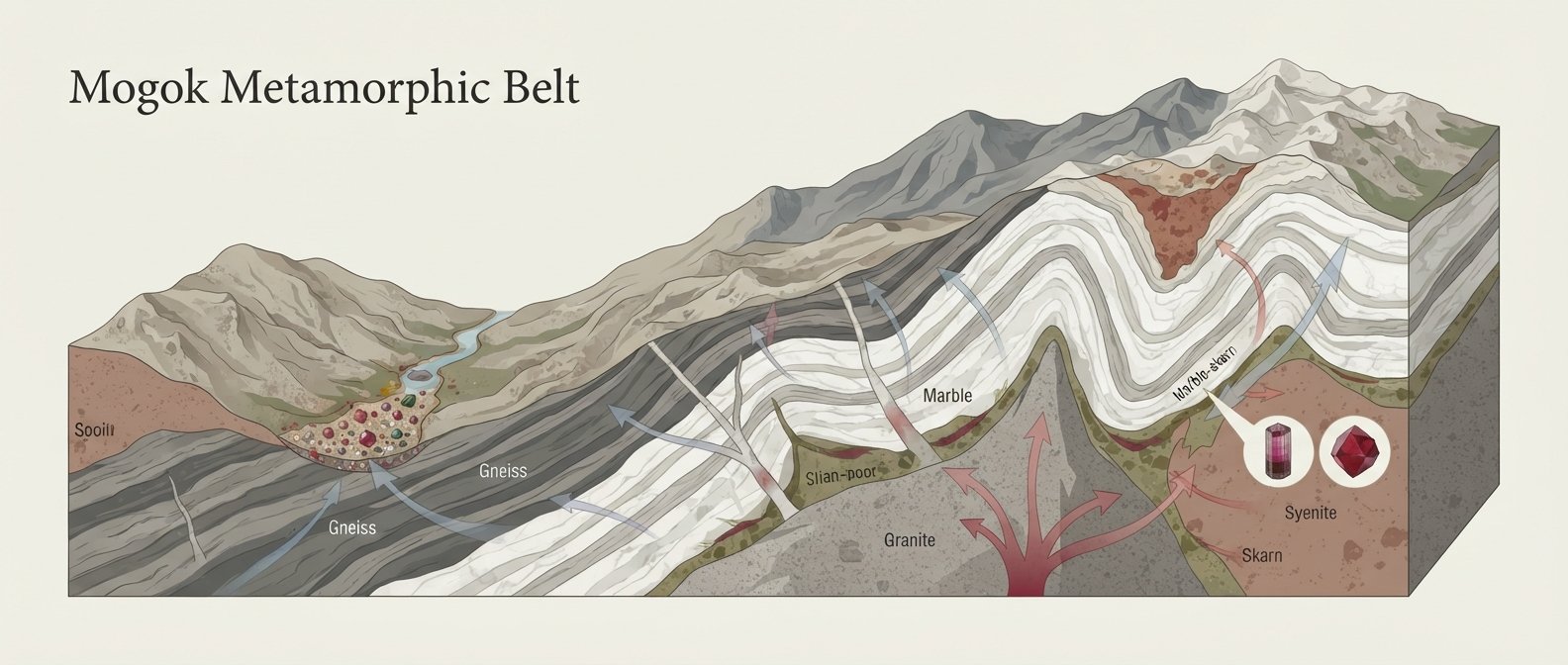
The Mogok Metamorphic Belt includes marbles, calc-silicate rocks, paragneisses, quartz-rich rocks, granitoids, and other high-grade metamorphic lithologies. In the Mogok gem districts, marbles are especially important and are interlayered or spatially associated with gneiss, syenite, charnockite, and calc-silicate rocks.
These rocks supplied contrasting chemical ingredients:
| Rock or precursor | Important chemical contribution | Possible mineral consequence |
|---|---|---|
| Limestone and dolostone | Calcium, magnesium, carbonate-rich, and commonly silica-poor conditions | Marble-hosted ruby, spinel, calc-silicates, ancalc-silicates, and related minerals |
| Clay-rich sediment | Aluminum, silicon, alkalis, and minor elements | Sillimanite, mica, feldspar, and corundum, where silica is removed or limited |
| Gneiss and granitoid rocks | Silica, aluminum, alkali-silicate calc-silicates, corundum, and incompatible elements | Feldspar, mica, tourmaline, zircon, and pegmatite-related minerals |
| Syenite and silica-poor intrusions | Alkalis and comparatively silica-poor reactive environments | Sapphire- and corundum-related metasomatic zones |
| Pegmatites | Water, boron, beryllium, lithium, phosphorus, and rare elements | Topaz, beryl, phosphorus, tourmaline, phosphorus capolite, and e-element minerals |
2. Intrusions and melt-related systems
Mogok contains syenite, charnockite, leucogranite, granite, and pegmatite-related rocks. The relationships between these rocks are complex, and ages reported for intrusions span different geological episodes. For example, many syenite ages have been interpreted as Early Jurassic, around 170–163 million years old, while other dates fall within younger metamorphic and tectonic events; later granite and pegmatite activity is commonly linked to post-peak metamorphic stages.
This matters because intrusions do more than add magma. They add heat, alter local silica activity, generate fluid pathways, and produce contact and metasomatic reaction zones in adjacent marble.
3. Fluids and metasomatism
Metamorphism and magmatism both release or generate hot fluids. These fluids can dissolve, transport, and redeposit chemical components. They can travel along:
- Faults and fractures
- Shear zones
- Grain boundaries
- Contacts between intrusive rock and marble
- Porous or reactive layers in metamorphic rocks
Where fluids encounter chemically different rocks, they can create reaction zones. In carbonate-rich settings, contacts with silicate-rich magma or fluid commonly produce calc-silicate skarns and other metasomatic assemblages.
In Mogok, the association of marbles with syenite/charnockite intrusions and calc-silicate skarns is central to modern interpretations of gem formation.
4. Low silica activity
One of the most important controls on corundum formation is silica availability.
Corundum is aluminum oxide. In a silica-rich environment, aluminum generally enters silicate minerals such as feldspar, mica, garnet, or sillimanite. Corundum becomes more favorable where aluminum is available but silica activity is sufficiently low.
This helps explain why marble, desilicated intrusive rocks, and certain metasomatic reaction zones can be favorable hosts for ruby and sapphire. In Mogok, silica-poor syenitic intrusions and marble-intrusion reaction zones are widely regarded as important in creating corundum-friendly conditions.
5. Weathering and secondary concentration
A large share of historically recovered Mogok gems comes from secondary deposits rather than directly from intact bedrock. Weathering breaks down marble, intrusive rocks, and altered host rocks; durable, dense minerals such as corundum, spinel, zircon, topaz, and tourmaline can survive transport and become concentrated in gravels.
In Myanmar, gem-bearing heavy-mineral concentrate is commonly called byon. Mogok sapphire mining is predominantly associated with such secondary deposits, although primary hard-rock mining also occurs.
The Role of Metamorphism
Metamorphism is the mineralogical and textural transformation of pre-existing rock under changed temperature, pressure, and fluid conditions, without complete melting.
Limestone, for example, recrystallizes to marble. If that limestone originally contained clay, organic matter, evaporitic layers, chromium-bearing material, or dolomitic layers, those minor constituents may become chemically important during metamorphism.
Pressure temperature conditions
The Mogok Metamorphic Belt records high-grade metamorphism, but no single pressure–temperature value represents the entire belt or every gem locality.
One influential geochronological and metamorphic reconstruction identified a late Eocene-Oligocene high-temperature event with sillimanite-grade metamorphism around 680°C, 680°C, and 4.9 kbar, followed by conditions of roughly 606–656°C and 4.4–4.8 kbar near 29 Ma.
Other work on granulite-facies paragneisses in the central belt estimates higher peak conditions, approximately 800–860 °C and 0.60–0.79 GPa, followed by lower-temperature conditions during exhumation.
These results are not necessarily contradictory: Mogok is a long, structurally complex belt, and different rocks may record different locations, stages, and degrees of metamorphic overprinting.
Timing: revise the simplified collision statement.
A simple statement that “Mogok formed during the India–Eurasia collision beginning around 50 Ma” is incomplete.
The India–Asia collision and its regional consequences are important context, especially for Cenozoic deformation and metamorphism. However, the Mogok belt preserves multiple metamorphic and magmatic events. Geochronological work has proposed:
- A Paleocene metamorphic event ending with post-kinematic granite dikes around 59 Ma.
- A later late Eocene–Oligocene event, approximately 37–29 Ma, associated with high-temperature metamorphism, monazite growth, zircon rim growth, and synmetamorphic melting.
- Younger leucogranite activity that crosscuts earlier fabrics.
The most accurate editorial framing is therefore
Mogok’s gem-bearing geology reflects a long, multi-stage tectonometamorphic history. Cenozoic events related to the broader India–Asia collision system strongly overprinted the belt, but they were not its only formative episode.
Magmatic and Hydrothermal Processes
Magma and residual melts
As magma cools, minerals crystallize selectively. The residual melt can become enriched in water and elements that do not easily enter early-forming minerals. In granitic systems, these may include boron, beryllium, lithium, phosphorus, fluorine, niobium, tantalum, tin, and rare-earth elements.
This process produces pegmatites: exceptionally coarse-grained igneous rocks that can host large and sometimes gem-quality crystals.
Mogok’s western areas include pegmatite-related deposits associated with the Kabaing granite. These are regarded as likely sources for pegmatite-related gem minerals such as topaz and aquamarine.
Marble intrusion reaction zones
In the Mogok and Kyatpyin valleys, marbles are intruded by syenite and charnockite bodies. These intrusions produced calc-silicate skarns in the surrounding marble.
That does not mean every sapphire crystallized directly from magma. The formation of Mogok sapphire remains more uncertain than the marble-hosted ruby spinel system. Some sapphires in syenitic rocks may be xenocrysts crystals formed elsewhere and later incorporated into the intrusion or may record multiple metasomatic and metamorphic processes.
The safest formulation is:
Syenite, charnockite, marble, skarn formation, metasomatism, and later metamorphism all appear to have contributed to sapphire mineralization in Mogok; the relative role of each process varies among deposits and remains incompletely resolved.
Why Certain Elements Become Concentrated
Most chemical elements are dispersed at low concentrations in common rock. A gemstone or rare mineral requires a local concentration mechanism.
Host-rock chemistry
A mineral can form only if its essential elements are present.
- Ruby requires aluminum and a trace chromophore, principally chromium.
- Spinel requires magnesium and aluminum.
- Sapphire requires aluminum plus color-producing trace elements, commonly combinations involving iron and titanium for blue colors.
- Tourmaline requires boron.
- Beryl requires beryllium.
- Kyawthuite requires bismuth and antimony, with minor tantalum documented in the analyzed specimen.
Fluid transport
Fluids may dissolve elements from one rock and precipitate them in another. A fluid can deposit a mineral when it cools, changes pressure, mixes with another fluid, reacts with a new host rock, or changes oxidation state, pH, salinity, or silica activity.
Chemical boundaries
The contact between carbonate-rich marble and a silica-bearing intrusion can be especially reactive. Each rock buffers fluid chemistry differently. This can produce narrow mineralized zones with compositions that do not exist in either original rock alone.
Structural pathways
Fractures, folds, faults, shear zones, and intrusive contacts create routes for fluid movement. Mogok’s deformation history therefore matters not just for regional tectonics, but for local mineral growth.
Why Mogok Is Famous for Ruby and Other Gems
Ruby: a marble-hosted system
Ruby is the red variety of corundum, with chromium as the principal red chromophore.
Mogok ruby is widely associated with marble-hosted deposits. Ruby and spinel are documented in relatively pure marbles, while many recovered stones occur in secondary gravels derived from those host rocks.
Specifically for the Mogok ruby, studies of fluid inclusions indicate the presence of sulfur-rich carbonic fluids and salt-rich residues. These fluids are thought to be linked to evaporitic lenses concentrated deposits of salts formed from evaporating water found interbedded within carbonate and shale layers. These geological conditions and fluid compositions play a crucial role in the genesis and characteristics of rubies in the region.
However, this should be stated cautiously:
Evaporite-derived components are supported by fluid-inclusion and related evidence in marble-hosted ruby systems, including Mogok material, but they are not a complete or universally demonstrated explanation for every ruby occurrence in the district.
The overall scientific consensus is stronger on the broad setting metamorphosed carbonate rocks, low silica activity, aluminum and chromium availability, and fluid-assisted recrystallization than on a single universal formation model for all Mogok rubies.
Spinel
In Mogok, it commonly occurs with ruby in marble-hosted environments. Magnesium supplied by dolomitic marble favors spinel formation; where comparable aluminum-rich, silica-poor conditions exist but magnesium availability differs, corundum may instead be favored.
Mogok is consequently renowned for spinel in a broad range of colors, as well as for ruby..
Sapphire
Sapphire is corundum in colors other than red. Mogok blue sapphires occur in a more complicated geological setting than ruby and spinel. Modern reviews link their distribution to syenite/charnockite intrusions, marble, skarn, and metasomatic zones, but emphasize that the exact sapphire-forming processes are still not fully resolved.
Mogok sapphire should therefore not be described as solely “pegmatite- and syenite-related.” A more precise statement is:
Mogok sapphire is associated with complex metamorphic and metasomatic environments near syenite and charnockite intrusions, and some deposits may involve more than one formation mechanism.
Other gemstones and minerals
Mogok produces ruby, spinel, sapphire, peridot, topaz, aquamarine, feldspar varieties, scapolite, tourmaline, zircon, garnet, and numerous collector minerals. Published summaries also list moonstone, fibrolite, danburite, enstatite, painite, and johachidolite among materials associated with the wider Mogok Stone Tract.
How Rare Minerals Form in the Same District
A single district can produce common rock-forming minerals, gem minerals, and extremely rare species because these categories require progressively narrower combinations of conditions.
| Occurrence type | Examples | Why it occurs |
|---|---|---|
| Common minerals | Calcite, dolomite, quartz, feldspar, mica | Broadly stable across common rock compositions |
| Gem minerals | Ruby, sapphire, spinel, peridot | Need suitable host chemistry, crystal-growth conditions, and transparency |
| Rare species | Kyawthuite, painite, johachidolite and others | Require unusual combinations of scarce elements and narrowly favorable conditions |
| Collector associations | Skarn and pegmatite assemblages | Reflect localized fluid–rock reaction and complex chemical evolution |
Rarity may result from:
- Scarce chemical ingredients.
- A narrow pressure temperature stability range.
- An unusual oxidation state.
- Restricted fluid compositions.
- Formation in only tiny pockets.
- Poor preservation during weathering.
- Limited access, sampling, or analytical study.
Kyawthuite and Mogok
Kyawthuite is a verified mineral species. t was approved by the International Mineralogical Association as IMA 2015–078 and formally described by Anthony R. Kampf, George R. Rossman, Chi Ma, and Peter A. Williams in Mineralogical Magazine in 2017.
Why Geological Context Matters
A mineral name and chemical formula are only part of a scientific description. To understand origin, researchers also need:
- Locality: The most precise possible location.
- Host rock: Marble, pegmatite, skarn, gneiss, or alluvial gravel.
- Associations: Which minerals occur together.
- Paragenesis: The order in which minerals formed.
- Textures: Whether a crystal grew in a cavity, replaced another mineral, or was transported.
- Fluid inclusions: Tiny trapped fluids that can preserve evidence of temperature and chemistry.
- Trace-element chemistry: Chemical fingerprints useful in reconstructing growth environments.
- Provenance: The documented chain from collection site to specimen.
Could Mogok Yield New Minerals?
Yes, it is possible but it should not be framed as a prediction.
Several factors make future discoveries possible:
- Mogok contains multiple mineral-forming environments: marble, skarn, syenite, charnockite, granite, pegmatite, altered rocks, and secondary gravels.
- Geological mapping and bedrock access remain uneven in a rugged and historically difficult-to-access region.
- Modern techniques such as electron-microprobe analysis, Raman spectroscopy, X-ray diffraction, LA-ICP-MS, and micro-focused crystallography can characterize tiny crystals that would previously have been overlooked.
- Museum, laboratory, and private collections can contain unidentified or misidentified specimens.
- New mineral species are commonly recognized from extremely small quantities of material when composition and crystal structure prove distinct.
The appropriate conclusion is:
Mogok remains a credible setting for future mineralogical discoveries because of its geological complexity and long history of producing unusual gem and collector material. But no particular new species or discovery can be predicts
Why is Mogok famous for gemstones?
Mogok combines chemically diverse rocks, high-grade metamorphism, intrusive magmatism, fluid rock reactions, low-silica corundum-forming environments, and secondary gravel concentration. These processes produced important deposits of ruby, spinel, sapphire, peridot, and many other gem and collector minerals.
What is special about Mogok geology?
Mogok lies in the long Mogok Metamorphic Belt, where marbles, gneisses, calc-silicate rocks, syenites, charnockites, granites, pegmatites, and structural fluid pathways occur together. The overlap of these environments creates many different chemical settings for mineral growth.
Why are rubies found in Mogok?
Ruby formed principally in low-silica, aluminum-bearing marble environments with chromium available as a trace color-producing element. Metamorphism, fluids, and local interaction between carbonate rocks and intrusions all contributed. Some studies indicate an additional role for evaporite-derived components in marble-hosted ruby formation, but the importance of that mechanism differs among deposits.
What minerals are found in Mogok?
Mogok is known for ruby, sapphire, spinel, peridot, topaz, aquamarine, tourmaline, feldspar varieties, scapolite, zircon, garnet, painite, johachidolite, kyawthuite, and many other minerals, alongside common rock-forming minerals such as calcite, dolomite, quartz, feldspar, and mica.
Why are some Mogok minerals extremely rare?
Rare minerals may require scarce elements, a narrow pressure–temperature range, particular fluid compositions, unusual oxidation conditions, or formation in very small volumes. Some are also underreported because difficult access and alluvial transport obscure their primary source rocks
Is kyawthuite from Mogok?
Yes. Kyawthuite was described from a waterworn alluvial crystal collected in the Chaung-gyi Valley near Mogok. Its inferred pegmatite origin is chemically plausible, but its original bedrock host has not been identified.
Could new minerals still be discovered in Mogok?
Possibly. Mogok’s geological variety, unevenly documented bedrock, active gem recovery, and improved analytical methods make future discoveries plausible. That does not guarantee any particular discovery.
What geological processes form gemstones?
Gemstones may form through metamorphism, magmatic crystallization, pegmatite formation, hydrothermal deposition, metasomatism, skarn formation, or volcanic transport. Weathering can later free durable crystals from their host rocks and concentrate them in alluvial or eluvial deposits.