
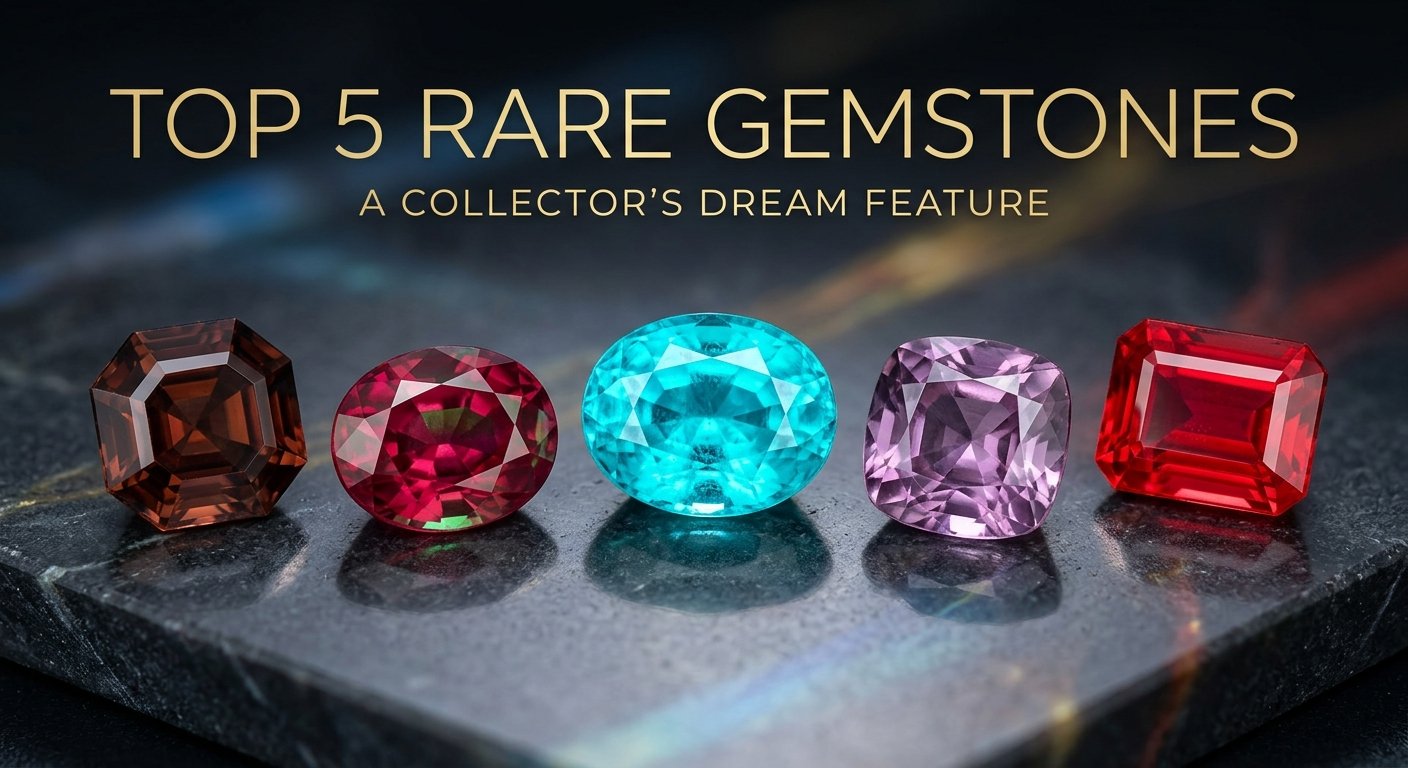
Some gemstones are so rare that even experienced collectors may never have the opportunity to own one rare gemstone. While diamonds, rubies, and emeralds dominate the jewelry market, a fascinating world of exceptionally scarce minerals exists beyond these familiar names. These extraordinary gemstones are prized not only for their beauty but also for their unusual geological origins, scientific significance, and limited availability.
Table of Contents
What Makes a Gemstone Truly Rare?
Before exploring individual gemstones, it is important to understand that rarity has several different meanings in gemology.
Mineralogical rarity
Mineralogical rarity refers to how uncommon a mineral species is in nature. Some minerals have been identified in only a very small number of specimens or localities. Others are more widely distributed but occur in extremely limited quantities suitable for cutting into gemstones.
Gem-quality rarity
A mineral may occur naturally without producing attractive, transparent crystals suitable for faceting. The number of gem-quality specimens can therefore be far smaller than the number of known mineral specimens.
Market rarity
Market rarity describes how difficult a gemstone is to purchase. A stone might exist in private collections, museums, or research institutions without appearing regularly on the commercial market.
Commercial desirability
Commercial desirability depends on factors such as color, transparency, size, durability, cutting quality, consumer recognition, and collector demand.
The Top five profiles
Kyawthuite
Species and chemistry.
Kyawthuite is a bismuth-antimony oxide with the formula Bi³⁺Sb⁵⁺O₄, the only approved Bi-Sb oxide mineral. I recall it as monoclinic; confirm this against the type description in Mineralogical Magazine.
Discovery and naming.
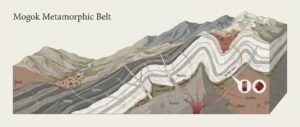
The crystal was found in 2010 in alluvium in the Chaung Gyi Valley near Mogok. The International Mineralogical Association (IMA) recognized it in 2015. The name honors Kyaw Thu, the dealer who secured the crystal for study.
Character and supply.
It is a transparent reddish-orange crystal weighing 1.61 carats. The type material is held in the Mineral Sciences Department of the Natural History Museum of Los Angeles County under catalog number 65602.
Faceted gem?
No faceted market exists. The only known stone is a museum specimen.
Price evidence.
None exists. A synthetic compound of nearly the same composition is already known, which matters greatly for fraud risk.
Who should buy it?
Nobody. Visit the museum.
Painite
Species and chemistry.
Painite is a calcium zirconium geology in aluminum borosilicate, CaZrBAl₉O₁₈, with small amounts of hafnium and titanium. It is hexagonal.
Discovery.
British gem dealer Arthur C.D. Pain found the first crystal, and it was identified as a new mineral in 1957. A third crystal was identified in 1979, and a fourth was not found until 2001. Until late 2004, only two had been faceted. Guinness listed painite as the rarest gem from 1981 to 2005.
Why it is rare.
Zirconium and boron do not normally associate in nature and do not occur together in any other mineral.
Sources and supply.
Painite occurs only in Myanmar. By 2005 new discoveries had made painite more abundant. A secondary summary of GIA’s reporting says more than 167 faceted stones were known at the time, mostly 0.05–0.30 carats. A dealer-run site also notes no large-scale mining operation targets painite. Treat this as a dealer observation, not a verified production statement.
Visual and physical character.
The colors run from red to brownish red. Some sources describe a Mohs hardness of 8 but notable brittleness.
Price evidence, labeled by type:
- Auction results: none verified in this research.
- Editorial claims: some articles repeat a figure of about $50,000 per carat for facetable painite. I could not trace that to a documented transaction.
- Dealer asking prices (reviewed October 2026): a secondary review lists a certified 0.39-carat Mogok stone at $440, about $1,128 per carat, and other verified-seller stones at roughly $10,000 per carat. The same source cautions against averaging these tiers into one number.
- Unverified internet claims: marketplaces show certified-looking painite at very low prices. Treat these as warning signs, not benchmarks.
Risks.
Species misidentification is the main one. Painite’s brownish red can overlap with garnet and tourmaline at a glance, so a laboratory species report is essential. Also watch for tiny sizes sold with big-ticket rhetoric.
Collector grade.
Look for a transparent, well-cut stone over 1 carat with a strong red color and a laboratory report.
Who should buy it?.
Advanced collectors who value documented species. Avoid it if you need easy resale.
Taaffeite
Species and chemistry.
Taaffeite is a beryllium magnesium aluminum oxide with the formula Mg₃Al₈BeO₁₆. It is hexagonal.
Discovery.
Taaffeite is the only gemstone first identified from a faceted stone. That makes its history a lesson in how many “spinels” in old collections might be something rarer.
Sources and supply.
It is increasingly found in alluvial deposits in Sri Lanka and southern Tanzania, and lower-grade material occurs in China. A well-known dealer’s estimate is that perhaps one in five thousand mine-run Tunduru spinels belongs to the taaffeite family. That is anecdotal but informative.
Price evidence.
- Editorial estimate: roughly $35,000 per carat for taaffeite. Treat it as a ceiling-style claim, not a market price.
Risks.
The biggest risk is confusion between taaffeite and musgravite and between either and spinel. Routine gem-testing instruments cannot reliably separate them.
Collector grade.
An untreated, well-colored stone over 1 carat with a laboratory identification that names it?
Who should buy?
Advanced collectors who value mineralogical interest and accept small sizes. Avoid it if you want size or brilliance.
Musgravite
Species and chemistry.
Musgravite is a close relative of taaffeite. One dealer source gives trigonal symmetry and the formula BeMg₂Al₆O₁₂. Another gives a general formula with iron and zinc substitutions. Formula conventions differ across sources, so cite your laboratory report, not a brochure.
Discovery.
It was first identified in 1967 in the Musgrave Ranges of South Australia. That original material was not gem-grade. Facet-quality musgravite was not reported until 1993, and by 2005 only eight specimens were known.
Supply, with a warning.
Published supply claims are inconsistent, which tells you the data are thin:
- One dealer says fewer than 100 gem-quality specimens are known.
- Another says fewer than a few dozen faceted stones exist.
- Third suggests under 200 stones above one carat.
Treat every figure as marketing-grade.
Risks.
Dealer expertise warns that some stones sold as taaffeite are probably musgravite, and that routine gem instruments cannot confirm it. Insist on advanced laboratory analysis, for example, from GIA, Gübelin, or SSEF.
Price evidence.
No credible documented transaction found. Editorial sources group it with taaffeite near $35,000 per carat, but that is not a transaction record.
Collector grade.
A documented, untreated stone with strong color, laboratory confirmation of species, and a clear provenance history.
Who should buy it?
Museum-level or serious specialist collectors. Avoid it unless you can verify the lab credentials and accept near-zero price transparency.
Red beryl
Species and chemistry.
Red beryl is a variety of beryl (Be₃Al₂Si₆O₁₈, hexagonal). Its dark red color is attributed to Mn³⁺ ions. It was formerly known as bixbite, a name you should avoid because it invites confusion with the unrelated mineral bixbyite.
Discovery.
It was first noted in 1904, and the main gem source, the Ruby-Violet claim in the Wah Wah Mountains, was found in 1958.
Supply.
The only known commercial occurrence of gem-quality red beryl is the Ruby-Violet Mine in the Wah Wah Mountains. According to the Utah Geological Survey, red beryl occurs once for every 150,000 diamonds. A secondary summary of GIA’s Gems & Gemology (Winter 2003) states that the Wah Wah Mountains produced a total of over 60,000 carats of red beryl from 1978 to 2003, of which only about 10% is facetable. Take that figure on faith, and check it against the original article.
Conflicting reports on the status of mine. The Ruby Violet Mine is played out, one dealer says, and rumors of a new mine have not materialized. Some talk of continuity of supply. Ask any seller directly and expect a non-committal answer.
Price evidence.
- Auction results: none verified.
- Dealer claims: a dealer writes that most faceted stones are under half a carat, and top 2–3 carat stones command over $20,000 per carat. Aggregator pages say $500 to $30,000 per carat across all grades. Treat these as asking-price ranges.
- Specimens: One dealer’s mineral-specimen pages show red beryl on matrix from $74.99 to $2,399.99 each. That is a very different, far more accessible market than faceted gems.
Risks.
Origin disputes, confusion between matrix specimens and facet-grade crystals, and the occasional dubious claim of a non-Utah source. Other occurrences in New Mexico and Mexico have produced only non-gem crystals.
Collector grade.
A transparent, vivid, untreated, well-cut stone over 1 carat with a laboratory report supporting natural origin and, ideally, Utah provenance.
Who should buy it?
Entry-to-advanced collectors. It is the most obtainable of the five and has the clearest single-source story. Avoid it if you cannot verify the origin.
Kyawthuite: The Ultimate Rarity and Why It Is Not a Normal Purchase
What is confirmed?
Kyawthuite is known from a single gemstone from near Mogok, recognized by the IMA in 2015. The museum has it on display. The mineral’s rarity is based on confirmed natural occurrence, not on market demand.
Why there is no market.
A holotype (the specimen that defines a species) belongs to science. A museum cannot responsibly sell it. A museum would not sell it, and no other natural crystal is known.
Why a listing is not proof.
A near-identical synthetic compound is already known. Anyone could attach the name to a synthetic or a misidentified orange crystal. I came across mix valid reporting with dealer-style promotion, so do not treat them as proof of anything.
Documentation that would be required before taking any claim seriously:
- A peer-reviewed type description (IMA-approved) and the museum’s own catalog data.
- Independent mineralogical analysis (X-ray diffraction and chemistry) of the exact object, performed by a recognized institution.
- An unbroken chain of custody from the discovery site.
- Explanation of how this object differs from the museum holotype and from the known synthetic.
- Written confirmation from the museum or the authors of the original description.
A certificate alone is not enough.
Certificates can be forged, issued by unrecognized labs, or can describe a different object. Verify any report directly with the issuing laboratory, and confirm that it explicitly identifies kyawthuite.
What is actually for sale.
Ranking by real-world collectibility:
Most obtainable for serious collectors.
Benitoite, red beryl (small stones and specimens), modest grandidierite, color-change garnet, alexandrite, demantoid garnet and Paraíba tourmaline.
Rare but intermittently available.
Fine red beryl, painite (small to mid-size certified stones), jeremejevite and poudretteite.
Specialist-only acquisitions.
Taaffeite and larger or better painite. Expect long waits and private conversations with dealers.
Museum-level or effectively unobtainable.
Kyawthuite (museum-only), exceptional musgravite and historic type-locality specimens.
Where genuine material appears:
- Specialist gemstone dealers with documented relationships to cutters and miners.
- Established mineral-specimen dealers, especially for crystals on matrix and locality-labeled material.
- Major auction houses, which vet consignments and publish lot histories.
- Gem shows, useful for handling stones, though you should still demand reports.
- Private collections and estate sales, where old labels can add real provenance value but can also hide misidentifications.
Why open marketplaces and social media carry more risk.
Ultra-rare species are expensive to fake, mislabel or inflate, and buyers rarely have comparable sales to check against. Anonymous sellers, recycled photos, “certificates” from unknown labs and urgent-sale pressure are the usual pattern. For anything near the top of the rarity pyramid, an open marketplace is the wrong venue.
Market analysis
Supply concentration and single-locality risk. Painite comes only from Myanmar. Red beryl’s commercial source is one Utah area. Political, environmental, or mining-status changes can freeze supply overnight. That can raise prices, but it can also expose you to sudden disruption and weak documentation.
Jewelry versus mineral collectors. Jewelry buyers want size, brilliance and wearability. Mineral collectors prize crystal form, matrix and locality. The same species can trade in two different markets at different price scales, as the red beryl specimen-versus-gem split shows.
What moves price. Color, clarity, size, cut quality, provenance and untreated status. For ultra-rare species, laboratory identification is itself a price factor, since the wrong species label can erase value.
The provenance premium. Old collections and documented locality labels often command more, because they reduce uncertainty. They can also contain outdated identifications, so verify them.
Comparable sales. The central difficulty. Few transactions are public, stones are not standardized and asking prices are not sales. A buyer often has no reliable benchmark.
Bid-ask spreads and liquidity. Dealers buy at a discount to what they sell for, and rare-species buyers are few. Expect a wide gap between what you pay and what you can realistically get back, and a long time to find a buyer.
Insurance and appraisal. Insurers and appraisers may lack comparables for a species with a handful of sales, so valuations can be conservative, disputed or hard to obtain. Specialist insurance and periodic reappraisal are essential.
Why price per carat misleads. Per-carat figures assume a smooth price curve. For rare species, a 0.3 ct stone and a 3 ct stone are different markets, and a single outlier sale can dominate any “average.” As one analysis above stressed, different quality tiers should never be averaged into one universal number.
Authentication and due diligence checklist
- Get an independent laboratory report that names the species, origin and treatment.
- Verify the report directly with the laboratory using its number.
- Confirm natural origin, treatments and species identification. Do not rely on the seller’s description.
- Request high-resolution photos, video, dimensions, weight and condition details.
- Examine provenance and chain of custody.
- Confirm locality claims where they affect value.
- Review the return policy, seller reputation and payment protections.
- Use an independent gemologist for any significant purchase.
- Secure export, import and origin documentation where applicable, including regulatory compliance for goods from Myanmar and other sensitive sources.
- Obtain specialist insurance and an updated appraisal.
Institutions to consult: Major gemological laboratories such as GIA, Gübelin and SSEF; museum mineralogy departments; national mineralogical societies and the IMA‘s published species data; and established auction houses with published catalogs. Do not state or imply that any laboratory tested a stone unless the report says so.
Red flags
- “World’s rarest gemstone” with no independent report.
- A vague or unverifiable certificate.
- A price far below any dealer’s range.
- No treatment disclosure.
- Photos that are inconsistent or look reused.
- No return policy.
- The seller refuses to provide the report number.
- Kyawthuite, or any ultra-rare species, offered in quantity.
- Claims of famous origin with no paperwork.
- Artificially enhanced or oddly saturated color.
- Confusion between similar species (taaffeite, musgravite, spinel, garnet, tourmaline).
- No provenance for a high-value mineral specimen.
- Pressure to buy quickly or pay outside protected channels.
- “Investment guaranteed” or “price always rises” language.
Collector other choices
- Grandidierite: An orthorhombic borosilicate-aluminate first found in Madagascar in 1902, with cyan to bluish-green colors; large transparent faceted stones are extremely rare.
- Benitoite: California’s blue gem, from San Benito County; a strong entry point for collectors.
- Alexandrite: the classic color-change chrysoberyl; the best-documented fine stones carry a major premium, and synthetic lookalikes are common.
- Poudretteite and jeremejevite: rarities that appear occasionally in tiny sizes.
- Demantoid garnet and Paraíba tourmaline: examples of rare stones with commercially stronger collector markets, meaning more dealers, more buyers and clearer price signals.
Pingback: Rare Gemstones: How to Collect Them and Buy Safely - KYAWTHUITE