
Table of Contents
How Much of Earth’s Mineral Diversity Do We Actually Know?
Since humans have been documenting minerals for thousands of years, undiscovered minerals still exist, or it is clear to conclude that the list is complete. It isn’t. Just over 6,000 mineral species are officially recognized by the International Mineralogical Association (IMA), and the list is constantly expanding. Numerous new species have been described every year by researchers in recent years.
If scientists have studied Earth’s rocks for centuries, how can completely new minerals still be discovered?
The first step in the solution is realizing that finding a mineral is not the same as finding a rock with an interesting appearance. You may learn very little from a striking color, an unusual shape, or a brilliant shine. Some of the minerals that have lately been described are small, dull, and only visible under a microscope. A unique mix of chemistry and atomic structure that has never been recorded before, along with proof that it originated spontaneously, are what define a novel mineral.
What Counts as a New Mineral?
Mineralogists use several terms that sound similar but mean different things.
A new specimen is simply another sample of a mineral already known. Finding a beautiful new quartz crystal in a new cave does not add to the mineral list.
An unusual variety is a known mineral with a distinctive appearance, usually caused by trace impurities or structural defects. Ruby and sapphire are both varieties of the mineral corundum. Their colors come from trace elements, not from a different mineral species. Gemstone names often describe appearance or market identity, not mineralogical identity.
A new mineral species is what the IMA’s Commission on New Minerals, Nomenclature and Classification (CNMNC) evaluates. In broad terms, a species must be naturally occurring, formed by geological processes, and have a distinct combination of chemical composition and crystal structure. Synthetic materials made in a laboratory are not minerals in this sense, however useful they may be.
A new crystal structure means the atoms are arranged in a pattern not previously documented. Two minerals can share the same chemical formula yet be different species if their atoms are arranged differently. Diamond and graphite, both pure carbon, are the classic example.
A new chemical composition means a mineral with a different chemistry. A mineral can share a crystal structure with a known species but differ in its dominant elements. In that case it is usually a separate species, because the dominant chemistry controls how it is classified.
This system of formal mineral classification exists so that a name means the same thing everywhere. Without it, two laboratories could describe the same material differently or give one name to two different substances.
How Scientists Discover New Minerals
Modern mineral discovery follows a fairly consistent workflow, though the details vary from case to case.
Field collection.
Geologists, mine workers, collectors, or museum staff obtain a sample. This may come from fieldwork, mining operations, gem gravels, or drill cores.
Geological documentation.
Researchers record where the sample came from, what rocks surround it, and how it formed. This context is scientifically essential, because a mineral with no known origin is far harder to interpret.
Initial observation.
Examination under a microscope reveals color, luster, crystal shape, and associated minerals. This step can suggest something is unusual but cannot confirm it.
Chemical analysis.
Techniques such as electron microprobe analysis measure which elements are present and in what proportions.
Crystal-structure analysis.
X-ray diffraction reveals how atoms are arranged. This is the heart of crystallography, and it is often the decisive step.
Comparison with known minerals.
Researchers check the data against existing records to confirm that the chemistry and structure do not match any established species.
Scientific characterization.
Physical and optical properties, density, andX-ray and hardness are measurable, and spectroscopic data are documented.
Formal recognition.
The findings are submitted as a proposal to the IMA’s CNMNC. Reviewers evaluate the evidence, and approved species are then published in the scientific literature. A portion of the type material is typically deposited in a museum or similar institution so others can examine it.
Why Can Earth Still Hide Unknown Minerals?
Remote regions. Large areas of the planet have been geologically studied only in broad terms. Detailed mineralogical sampling is sparse in some mountain ranges, polar regions, and dense forest or desert terrain.
Deep geological environments. Direct access ends at a few kilometers of drilling depth at most, and most mineral collecting happens at or near the surface.
Microscopic crystals. Many mineral species occur only as grains far too small to see unaided. They can be overlooked for decades simply because nobody examined the material at the right scale.
Rare element combinations. Earth’s crust is dominated by a limited set of common elements. Minerals built from unusual combinations of less abundant elements form only where those elements happen to be concentrated together. Such conditions are uncommon.
Inaccessible rocks. Some deposits are buried, flooded, or located in areas where sampling is impractical.
Unusual pressure-temperature environments. Certain minerals form only under narrow physical conditions, which limits where they can appear.
Tiny quantities. A mineral may exist in only a small pocket of rock. Statistical studies of the mineral record have noted that a substantial minority of known species are documented from only a single locality, which suggests that rarity and limited distribution are common features of mineral diversity.
The Deep Earth Problem
Earth’s interior is the largest region we cannot sample directly. The crust is the thin outer layer we can study. Beneath it lies the Earth’s mantle, which makes up most of the planet’s volume. Deeper still is the core.
Our knowledge of the mantle comes from several indirect and semi-direct sources:
- Seismic waves, which reveal how rock properties change with depth.
- Mantle fragments brought to the surface by volcanic eruptions, including xenoliths.
- Diamond inclusions, tiny mineral grains trapped inside diamonds that formed at great depth.
- Laboratory experiments that recreate extreme conditions.
The familiar minerals of the mantle are subjected to the tremendous pressure and temperature of the mantle, and they transform into more dense structures. Such changes are called high-pressure phases. Scientists have also recorded mineral changes associated with seismic discontinuities, places where rock properties change abruptly with depth.
Could Minerals Exist Only for Tiny Geological Windows?
Yes, and this is one of the more useful ideas for understanding why some species are so rare.
Every mineral forms within a particular set of conditions. Temperature, pressure, chemical environment, oxygen availability, and fluid composition all influence which minerals can crystallize. For common minerals such as quartz or feldspar, those conditions are met in an enormous range of settings.
For other minerals, the requirements are far narrower. A mineral might need a specific ratio of several elements, a particular oxidation state, and a certain temperature range, all at once. That combination may occur only in a small pocket of rock or only briefly as fluids move through it. If conditions then change, the mineral may break down or be replaced.
This helps explain extreme rarity. A species may have formed many times throughout Earth’s history, but the conditions that allow it to form and survive are so specific that examples are almost never preserved or found. Mineral evolution research, which studies how Earth’s mineral diversity changed as the planet’s chemistry and processes changed, reinforces the idea that environment shapes which minerals appear.
How Technology Is Changing Mineral Discovery
Much of modern mineral discovery is driven by instruments, not new field expeditions.
- Electron microscopy reveals fine detail in grains too small for optical study, including internal structure and chemical zoning.
- X-ray diffraction, including single-crystal methods and synchrotron-based approaches, determines atomic arrangement even in very small samples.
- Spectroscopy techniques such as Raman and infrared provide structural and chemical fingerprints that help distinguish similar materials.
- Microanalysis, including electron microprobe analysis, measures composition at the micrometer scale.
- Automated mineral analysis systems scan large numbers of grains and map which minerals are present. This allows researchers to flag unusual grains that a human might never have noticed.
- High-pressure laboratory experiments, using devices such as diamond anvil cells, reproduce deep Earth conditions and help predict or interpret high-pressure phases.
- Improved databases, including reference collections such as the RRUFF project and Mindat, make it easier to compare new data with existing records quickly.
Technology does not create minerals. What it does is reveal that something previously treated as ordinary material is actually distinct. A tiny grain once filed under a familiar name can turn out, under modern analysis, to have a different structure or chemistry.
Why Meteorites and Extreme Environments Matter
Meteorites are fragments of other bodies or of early solar system material, and they have experienced conditions unlike most of Earth’s crust. Some have also been subjected to intense shock.
That combination explains why they matter for mineralogy. Shock events can produce high-pressure minerals that also exist in Earth’s deep interior but are almost never available at the surface. The naming of bridgmanite from a shocked meteorite is the best-known example. Impact craters on Earth can likewise produce minerals formed by sudden high pressure and temperature. Unusual oxidation environments, whether extremely oxidized or extremely reduced, can also favor unusual mineral assemblages.
A caution is needed. Not every unusual meteorite contains a new mineral. The great majority contain well-known species. Meteorites are valuable as a window into conditions that are otherwise hard to access, not as a guaranteed source of discoveries.
What Kyawthuite Teaches Us About Mineral Discovery
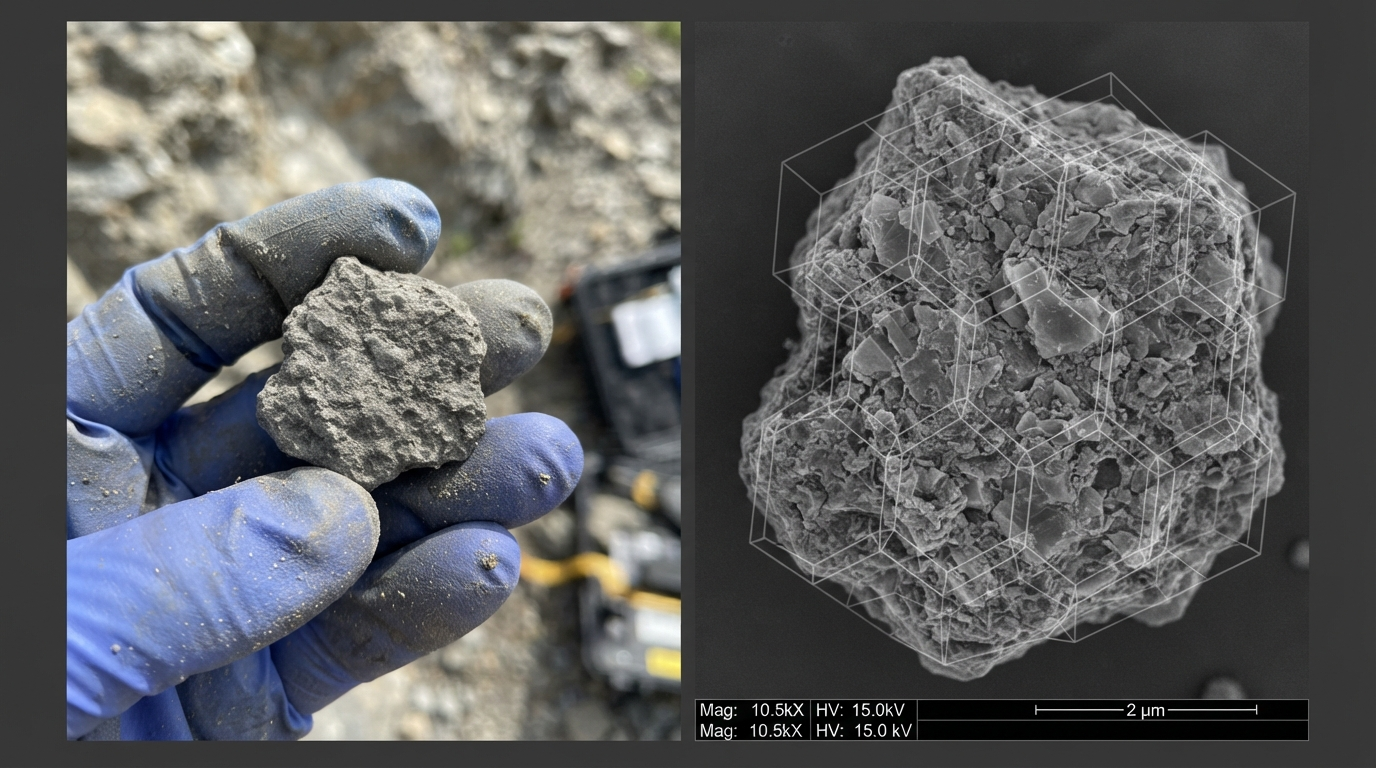
Kyawthuite offers a useful case study, and the lesson is broader than the mineral itself. It is a rare bismuth-antimony oxide from the Mogok region of Myanmar, a locality long known for gem-quality ruby and other gemstones.
The instructive part is how a mineral can remain obscure. Mogok has been studied and mined for gems for a very long time, yet this species was described only in the 2010s, from an exceptionally small amount of material. A rare mineral can sit unrecognized, not because nobody looked at the region, but because nobody had the right specimen and then analyzed it with the right tools.
The general pattern applies widely. A specimen must be recovered. Someone must recognize that it might be different. It must be analyzed chemically and structurally. The results must hold up to scientific review. Each step depends on human attention and available technology. A mineral can be fully real and fully present in the world for millions of years while remaining scientifically unknown until those steps align.
Could There Be Minerals We Have Not Found Yet?
Scientifically, several possibilities are reasonable. It helps to separate each from the level of evidence currently behind it.
Undiscovered minerals. New species continue to be described from known localities and new ones. The steady flow of approvals is direct evidence that the catalog is incomplete.
Minerals restricted to inaccessible environments. Deep crust and mantle settings may host species we cannot easily sample. This is plausible, and some deep minerals have indeed been found indirectly, but specific unknown species remain hypothetical.
Microscopic minerals. Given how many discoveries involve tiny grains, it is reasonable to expect more hiding in existing samples.
Transient mineral phases. Some phases may exist only briefly or break down rapidly upon exposure to air or changing conditions. These are hard to capture and document.
Minerals in extreme geological settings. Shock, very high temperature, or unusual chemistry may produce species that appear only rarely.
Mineral species awaiting formal characterization. Some unnamed or incompletely studied materials are already known to researchers but have not yet been fully analyzed and approved.
All of these are possibilities grounded in how discovery has worked so far. None amounts to a demonstrated prediction of what specific minerals exist, and it is important not to blur that line.
Are Scientists Close to Discovering All Earth’s Minerals?
The honest answer cannot be a simple yes or no, for four reasons.
First, the list keeps growing. If discovery were nearly complete, new approvals would be dwindling. Instead, researchers continue to describe new species each year.
Second, Earth’s environments are extremely diverse. Countless combinations of chemistry, pressure, temperature, and fluid activity occur across the crust and mantle, and each can in principle favor different minerals.
Third, discovery depends on sampling. A mineral cannot be described until someone obtains it. Regions and depths that are rarely sampled are more likely to hold surprises.
Fourth, technology keeps improving. Better instruments make it possible to identify grains and structures that were previously undetectable, which means old samples can yield new answers.
Some researchers have applied statistical methods to the mineral record to estimate how many species might remain undiscovered (undiscovered minerals). Such estimates depend on modeling assumptions, and this article does not offer a number. The responsible position is that the catalog is still expanding and that no one can state the final total with confidence.
Frequently Asked Questions
Are there still undiscovered minerals on Earth?
Very likely, yes. New mineral species are approved regularly, which shows the catalog is incomplete. No one can say precisely how many remain.
How does a mineral become officially recognized?
Researchers submit a proposal with chemical, structural, and physical data to the IMA’s CNMNC. The commission evaluates whether the species is genuinely distinct, and approved species are then published. Type material is usually deposited in a museum.
How many minerals are known?
Just over 6,000 species are currently recognized by the IMA. The number rises as new species are approved, so check the IMA’s official list for the current figure.
Can scientists create minerals that do not naturally occur?
Scientists can synthesize many compounds, including copies of natural minerals and entirely new materials. By definition, though, a mineral must occur naturally, so laboratory-made substances are not formally minerals.
Can a new mineral be discovered in an old rock collection?
Yes. Museum and private collections have yielded new species when old specimens were re-examined with modern instruments.
Why are some minerals found only in one location?
Some form only under very specific conditions that occur rarely. Others may be more widespread but unrecognized. Either way, limited occurrence is common among rare species.
Are new minerals still being discovered today?
Yes. New species are approved and published every year.
What is the difference between a new mineral and a new gemstone variety?
A new mineral is a distinct species defined by chemistry and crystal structure. A gemstone variety is a known mineral with a distinctive appearance, such as ruby within corundum.



Pingback: Mogok Geology: Why It Yields Rare Minerals and Gems - KYAWTHUITE